Reading the roles of Thom Yorke and Jonny Greenwood through Christopher O'Riley's transcriptions, and tracing the single thread that leads to their present-day solo work
Prologue: The Day Classical Listeners Went Looking for “Mr. Head”
In 2003, a strange wave of inquiries flooded NPR radio program From the Top. During a broadcast, listeners so moved by a piece the host-pianist had performed began writing in to ask: “Where can I find the beautiful music of this composer, 'Mr. Head'?”
“Mr. Head,” of course, was Radiohead.
The program's host, Christopher O'Riley, had been playing his own piano-solo arrangements of Radiohead songs — entirely unannounced, as if they were standard classical repertoire — in the same time slots he might otherwise fill with Debussy or Rachmaninoff miniatures. Classical listeners had assumed they were hearing music in the lineage of Bach or Debussy.
This “misidentification” is more than a charming anecdote. It stands as the most eloquent possible proof of the structural depth within Radiohead's music.
O'Riley: The “Eccentric” with Virtuoso Technique and Classical Intelligence
Christopher O'Riley is by no means an unknown amateur. He is a concert pianist who won prizes at all four of the world's premier competitions — Van Cliburn, Leeds, Busoni, and Montreal — and has performed with major orchestras including the New York Philharmonic, Los Angeles Philharmonic, and Philadelphia Orchestra. He began piano at age four, studied with Russell Sherman at the New England Conservatory, and has spent his career performing works of formidable technical demand: Prokofiev, Ravel, Shostakovich. That such a figure would turn his attention to Radiohead covers is itself remarkable.
O'Riley first encountered Radiohead in 1997, the year OK Computer was released. Stopped in his tracks by what he heard on the radio, he went on to devour not only official recordings but live bootlegs, B-sides, and unreleased material, eventually beginning to transcribe the music himself.
Five Players' Sound into One Piano: An Act of Near-Impossible Compression
Consider for a moment what this actually entails. Radiohead is a five-piece band: Thom Yorke on vocals and guitar; Jonny Greenwood on guitar, ondes Martenot, string arrangements, and electronic processing; Ed O'Brien on effects guitar; Colin Greenwood on bass; Phil Selway on drums. From OK Computer onward, this is further layered with Mellotron, electronic sound processing, and sampling — in effect, a fusion of rock band, electronic music, and chamber ensemble operating in multiple simultaneous strata.
O'Riley compresses all of this into a piano solo. Two hands. One sustain pedal.
He has spoken frankly about the difficulty: “My Radiohead transcriptions are among the most difficult things in my repertoire — including Prokofiev's Piano Concerto No. 2.” He cited a particular two-bar passage in “There There”: “It's roughly equivalent to the hardest moment in the Prokofiev concerto. It just happens forty times in a row.”
So what, concretely, is O'Riley doing?
First, there is voice redistribution. In Radiohead's music, vocal melody, guitar countermelody, and bassline run simultaneously as independent voices. O'Riley redistributes these across the full range of the piano: the vocal line sings in the upper register of the right hand, while the left hand supports bass and rhythm, and the middle register weaves in the guitar's countermelody. The voice-separation techniques used in playing Bach inventions and fugues find direct application here.
Then there is the translation of electronic texture. The floating quality of Jonny Greenwood's ondes Martenot; the “fog” created by Ed O'Brien's delay pedal; the inhuman quality of Yorke's electronically processed vocals — none of these seem reproducible on a purely physical instrument like the piano. O'Riley creates resonance and tonal blending through meticulous sustain pedal control, and approximates the electronic “roughness” by strategically placing dissonant harmonies. Critics have described this technique as “a translation deploying Ravel's harmonic sensibility and Shostakovich's use of dissonance.”
Finally, there is rhythmic reconstruction. The polyrhythms and syncopations of Phil Selway's drumming are transplanted to the left hand — but a mere transplant would be flat. Through what critics have called a “rhythmically unstable left hand,” O'Riley conveys the groove of the drums through variations in touch and subtle fluctuations of tempo.
He has described what draws him to Radiohead's music this way:
“Not one member of Radiohead may be able to read music. But each of them brings a thread of a particular idea or motive to a song. It's very similar to the interplay of multiple voices in a Bach fugue or a Shostakovich fugue.”
This perception is precisely what separates his arrangements from mere covers. Rather than simply “reducing” five players' worth of sound, he preserves the essential contrapuntal structure and rebuilds it across eighty-eight keys. It is an act of deconstruction and reassembly — work that only becomes visible through classical training.
O'Riley also knew that not every song could be translated. When he told Yorke, “I can't imagine playing 'Pyramid Song' on piano unless you're singing it,” that was a judgment: without Yorke's vocal as a voice, the heart of the piece disappears. Deciding which songs to choose and which to leave alone was itself part of O'Riley's art as an arranger.
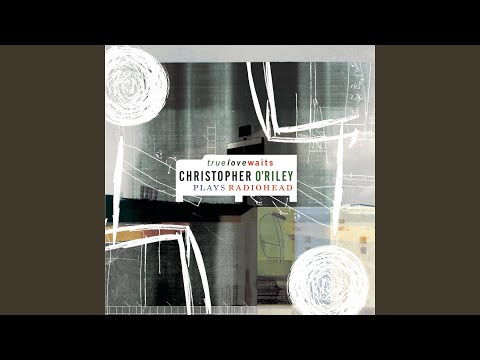
True Love Waits: Christopher O'Riley Plays Radiohead, released in 2003, earned four stars from Rolling Stone — a rating that, by all accounts, had effectively never before been awarded to a classical recording by that publication.
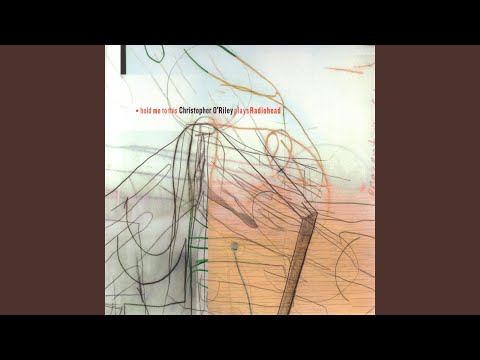
O'Riley and Thom Yorke: An Encounter of Self-Deprecation and Admiration
In the period around the album's release, O'Riley had the opportunity to speak directly with Thom Yorke. The record of that conversation illuminates both the nature of Radiohead's music and Yorke himself.
As O'Riley was preparing the cover album, mutual acquaintances warned him: “Don't be surprised if they hear your versions and say, 'Why would you bother covering us?'”
What O'Riley actually found when he met Yorke was a figure completely unlike his expectations.
When O'Riley mentioned, “I'm arranging a 1997 version of 'Lift' — I prefer the older version,” Yorke replied without hesitation: “Good. The new version is shit.” This unsparing self-criticism was entirely characteristic.
When O'Riley said he couldn't imagine playing “Pyramid Song” without Yorke singing it, Yorke shot back immediately: “Meaning it's only good if I ruin it?”
When O'Riley observed, “On its own, 'How to Disappear Completely' might just be guitar and vocals — ordinary, even. But the cloud of quarter-tone strings Jonny layered over it is what makes it unique,” Yorke fell quiet and smiled — barely, but unmistakably. It was the expression of someone who had just heard articulated something he himself had never put into words.
O'Riley later reflected: “He was an extraordinarily humble, self-deprecating person. We just spent the time talking about his wonderful music.”
O'Riley subsequently met the full band in Amsterdam, in a considerably more relaxed atmosphere. A kind of mutual respect had formed between the group working collectively and the pianist who engaged with their songs alone.
What this encounter reveals is that Yorke values his own music less than anyone else — not out of false modesty, but from the insatiable dissatisfaction with one's own work that perfectionism inevitably produces. The same impulse that drove him to push the rest of the band through the ordeal of Kid A in pursuit of a new direction.
The Bends (1995): The Completion of a Musical Identity, and the “Structure” Already Present
The multi-voiced structure that O'Riley identified in Radiohead was not confined to OK Computer and the experimental work that followed. It was already present, in embryonic form, with The Bends.
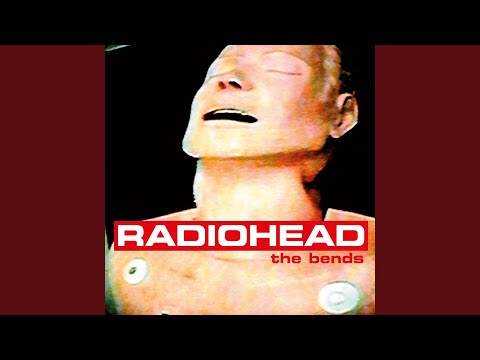
The Bends was released in March 1995 and reached number four on the UK Albums Chart. Five singles were released from it: “High and Dry” peaked at UK number 17, “Fake Plastic Trees” at 20, “Just” at 19, and the final single “Street Spirit (Fade Out)” at number 5. “Street Spirit” outperformed the previous benchmark of “Creep,” demonstrating that Radiohead were no one-hit wonder. The album ultimately went four-times platinum in the UK and platinum in the US.
More significant than the chart numbers is the fact that The Bends established Radiohead's compositional mode as a band. On Pablo Honey, nearly every song had been written by Yorke alone; on The Bends, each member's voice began for the first time to act autonomously. The guitar part of “Just” was constructed by Jonny Greenwood deploying an octatonic scale across four octaves, with the solo pitch-shifted into the upper register via a DigiTech Whammy pedal — an entirely original approach. “(Nice Dream)” began with Yorke's simple four-chord skeleton, which O'Brien and Greenwood then fleshed out by adding their own parts. “Fake Plastic Trees” was completed by a reversed process: producer John Leckie recorded a solo take of Yorke playing acoustic guitar, and the band then built up sound over it. “Black Star” was recorded on a day when Leckie was absent, with an engineer then still relatively new to the band — Nigel Godrich — sitting at the controls. That session marked the beginning of a lifelong partnership: Godrich would go on to produce every subsequent Radiohead record.
This diversification of creative roles gave each song independent voices of its own. In the Britain of 1995, dominated by Britpop at its peak, The Bends pointed in an entirely different direction from the nostalgic rock of Oasis. Pitchfork would later describe the Yorke–Jonny Greenwood songwriting partnership of this period as “comparable to Lennon–McCartney or Jagger–Richards.” Garbage and R.E.M. began naming Radiohead as a favourite band; The Cure contacted them to ask about the sonic approach of the album, hoping to apply it to their own work.
That O'Riley actively covered The Bends material is consistent with this reading. The track listing of True Love Waits (2003) includes five songs from the album: “Fake Plastic Trees,” “Bulletproof... I Wish I Was,” “Black Star,” “Thinking About You,” and “You.” Choosing The Bends songs alongside the experimental material from OK Computer onward says something important about O'Riley's curatorial eye: in his view, Radiohead's musical depth did not spring into existence with OK Computer. The multi-voiced structure of The Bends already warranted translation to the piano in its own right.
AllMusic's critic wrote of O'Riley's covers of The Bends material: “Darker, quieter numbers like 'Bulletproof' and 'Motion Picture Soundtrack' translate particularly well to the piano.” The introspective stillness of those songs and their interlocking voices have a natural affinity with the instrument — which is itself evidence that, even at this stage, Radiohead was already writing music that did not depend solely on “the sound of a rock band.”
What Is Radiohead: An “Accidental Fugue” in Five Voices
What, precisely, does O'Riley mean when he speaks of a “Bach-like structure”?
The essence of a Bach fugue is that multiple independent voices move simultaneously while organically interweaving. Each voice functions not as accompaniment but as an equal participant bearing its own subject. Radiohead's five members likewise each carried an irreplaceable “voice.”
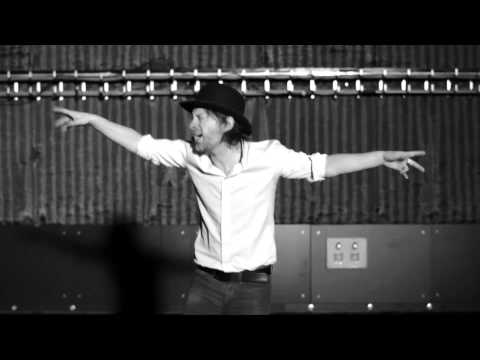
Thom Yorke is the primary source of the songs' skeletal framework, lyrics, and melody. He writes the bones of a song at the piano and brings it to the band. His vocal functions as an independent melodic voice that contends with the instrumental ensemble on equal terms.
Jonny Greenwood is the figure who brought the sensibility of contemporary classical music into the band: guitar textures, string arrangements, ondes Martenot, electronic processing — he designed what might be called “the acoustic space around the song.” When O'Riley observed that “it's the cloud of quarter-tone strings Jonny layered over 'How to Disappear Completely' that makes it unique,” and Yorke responded with a faint smile, the significance of that voice was something Yorke understood better than anyone.
Ed O'Brien creates “fog” and “space” in the sound through effects and guitar texture. A single choice of delay pedal setting can transform the entire acoustic environment of a track.
Colin Greenwood's basslines function not as simple low-end support but as an independent melodic voice with its own movement. The bass on Kid A's “Dollars and Cents” originated as improvisation he played while listening to Alice Coltrane records.
Phil Selway's drumming carries a jazz-inflected flexibility; rather than merely marking time, it engages in dialogue with the other voices.
Crucially, this “fugal structure” was never a deliberate design. Most band members cannot read music. Yet the musical intuitions and experiences each brought to the table accidentally produced something closely approximating what Bach constructed as formal theory: counterpoint arrived at unconsciously.
That said, none of this was yet in place on Pablo Honey (1993), where Yorke wrote the songs and the band performed them — straightforward alternative rock under the influence of Pixies and Dinosaur Jr. The autonomous voices began to emerge on The Bends (1995) and fully flowered on OK Computer.
OK Computer (1997): The Moment Electronica's Shadow Falls
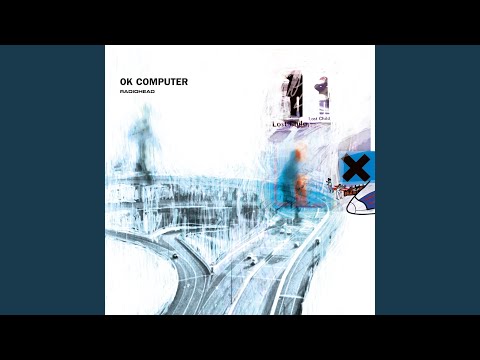
After the The Bends tour, Radiohead spent long stretches on the tour bus listening to Miles Davis's Bitches Brew (1970). Jonny recalled:
“In a sense we were arrogant. We'd listen to a record like Bitches Brew and want to do that — even though none of us owned a trumpet or had any desire to play one. There was an arrogance in thinking, 'Oh, we can do something like that.'”
Yorke explicitly named Bitches Brew's “unbelievably dense and terrifying sound” as the starting point for OK Computer. He also cited Ennio Morricone, the krautrock band Can, and DJ Shadow's sampling techniques as influences.
At this stage, the electronica influence is still germinal. The opening of “Airbag” had Phil Selway's drums recorded for sixteen minutes, then a few-second loop extracted and processed on a Macintosh to form the rhythmic core. The second half of “Karma Police” was rebuilt by Yorke and Godrich alone using samples and loops — a dry run for Kid A.
But OK Computer is fundamentally still collective work. Influences were shared; everyone was aligned on the direction.
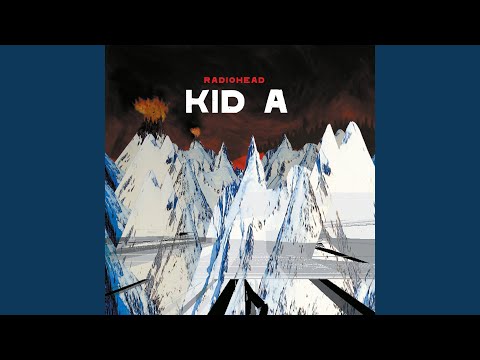
Kid A (2000): The Moment Yorke Nearly Broke Radiohead
After the global success of OK Computer, Yorke experienced a strange sense of loss. The emergence of Travis, Coldplay, and other bands imitating his sound provoked a visceral reaction; he stopped listening to rock entirely.
Walking the cliffs of Cornwall, what he listened to obsessively was Warp Records: Aphex Twin, Autechre, Boards of Canada. He would later describe Aphex Twin as having “opened another world to me — one that didn't need my electric guitar.”
The new material Yorke brought to sessions was incomplete: driven by sound and rhythm, often lacking lyrics or conventional structure. Jonny feared it would become “art for art's sake rock.” Colin couldn't warm to its coldness. Even producer Godrich was disoriented; other members seriously considered leaving. Yorke has acknowledged this directly:
“The other members couldn't figure out what to contribute. When you're working on synthesizers, you lose the sense of being in the same room as other people. I made it nearly impossible for everyone.”
Yet even here, the “accidental fugue” found a way to function. “Idioteque” began when Jonny handed Yorke a fifty-minute improvisation on modular synthesizer; Yorke found a forty-second fragment he felt was “absolute genius” and built the entire song around it. It was a moment where Yorke's electronic impulse and Jonny's acoustic design merged.
Kid A is the record made while the band was on the verge of collapse. And that experience prepared the ground for what came next.
The Eraser (2006): The Solo Work as Necessary Exit
After the Hail to the Thief (2003) tour, Radiohead entered a period of hiatus. During that time, Yorke sat alone with a laptop and began making music — music that became the 2006 solo album The Eraser.
This was not a rejection of Radiohead. Jonny said: “He needed to put this out. Everyone was glad he did.” Yorke himself repeatedly emphasised at the time of release: “I'd always wanted to do something like this. It came together easily and quickly. Radiohead is not breaking up.”
Most of the songs on The Eraser were pieces that had “not fit” within Radiohead — personal fragments of electronic music written in hotel rooms and on planes, material that couldn't be contained within the band's frame. The experience of pushing the rest of the band to their limits during Kid A had led to a simple resolution: the next electronic impulse would be followed alone, without bringing the band along.
Yorke went on to form the electronic band Atoms for Peace, and more recently launched The Smile with Jonny Greenwood. The Smile has been described as a freer and wilder project drawing more heavily on jazz, krautrock, and progressive rock.

Epilogue: A Chain of Fugues
A single line comes into focus.
Just as American Football's arpeggios, born on a midwestern night, drew inspiration from Steve Reich's minimalism. Just as O'Riley found Bach's fugues in Radiohead's music. Just as Yorke heard in Bitches Brew “something that accumulates while falling apart.”
Perhaps the depth of music lies in this: the same structural principle repeating across different eras, cultures, and forms, undeterred by the boundaries of genre. What O'Riley's piano demonstrated is the fact that Radiohead occupied a place beyond the frame of “rock band.”