Two Icelandic Post-Classical Composers: Jóhann Jóhannsson and Ólafur Arnalds
Description: Why does Iceland, a nation of 350,000 with virtually no music industry, produce composers who command orchestral language with such quiet authority? This piece traces the parallel lives of Jóhann Jóhannsson—who built an elegy around a discarded IBM computer his father once programmed to sing a hymn—and Ólafur Arnalds, a former metal drummer who accidentally became one of post-classical music's most distinctive voices. At its core, this is a story about what happens when you grow up without genre walls, and how proximity to other musicians can substitute for a conservatory education.
Post-classical music has a lineage that runs parallel to those trained at the Royal Academy or Berklee. It is a lineage of people who grew up without walls between genres—who reach for electronic sound and classical language alike as equally usable material. The two composers that the island nation of Iceland produced, virtually without a music industry infrastructure to speak of—Jóhann Jóhannsson and Ólafur Arnalds—are among the most vivid examples of this.
Jóhann Jóhannsson (1969–2018): An Elegy for a Discarded Computer
A Self-Taught Composer Without Formal Education
Born in Reykjavík, Jóhann Jóhannsson was essentially a self-taught musician. He began playing in bands as a teenager—the indie outfit Daisy Hill Puppy Farm and the alt-rock band HAM—gradually shifting his focus toward composition. He never worked through a conservatory curriculum. That fact is audible in his music: it carries a distinctive dryness that sets it apart from both academic minimalism and the sentimentality of conventional film scoring.
The IBM Computer's Sound: From a Tape His Father Left Behind
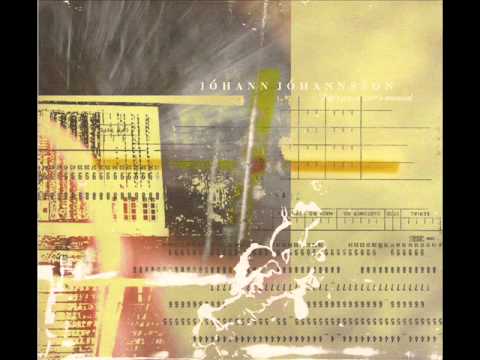
One of Jóhannsson's defining works, IBM 1401, A User's Manual (2006), was born from a family memory. In 1964, the IBM 1401 mainframe computer arrived in Iceland for the first time. Seven years later, when a newer model made it redundant, the chief engineer—Jóhannsson's father, Jóhann Gunnarsson—recorded the machine's final “performance” on a reel-to-reel tape.
His father had discovered that by running certain programs, the computer's stray electromagnetic waves could be picked up on a radio receiver—coaxing musical tones from a machine never designed to produce them. It was an early form of computer music.
The IBM 1401 was not built to play music. Yet its operators gave it the ability to sing—programming it to perform the Icelandic hymn “Ísland Ögrum Skorið” (composed by Sigvaldi Kaldalóns). Before it was decommissioned, they held a small funeral ceremony, recording their gratitude and their grief. The act of a computer singing a hymn is the literal origin of the prayer-like quality that pervades that album.
Jóhannsson took this tape and built a work for string orchestra and electronics around it. Mourning for a discarded machine, nostalgia for a lost technology—the fact that he could treat such material as legitimate compositional substance without hesitation may well be a product of having no formal training to tell him otherwise. Academic composition education can draw lines between what is “proper” material and what is not. Jóhannsson had no such lines.
A Film About Copenhagen: A Hidden Masterpiece
Jóhannsson also composed the score for Max Kestner's documentary Dreams in Copenhagen—a film that quietly captures the textures of everyday life in the Danish city. The music is unhurried and deeply unshowy, and compared to his major film scores, it is rarely discussed. Yet it is one of the works in which Jóhannsson's essential nature is most quietly concentrated.

Death at 48
Jóhannsson died in Berlin on 9 February 2018, at the age of 48. The cause was heart failure, with toxicology reports indicating that a lethal combination of cocaine and flu medication was likely responsible. Two years after his death, the only feature film he directed and scored—Last and First Men—had its world premiere at the 70th Berlin International Film Festival, where it received widespread critical acclaim. He died at the height of his creative powers, and that remains one of the most significant losses contemporary music has sustained.
Ólafur Arnalds (1986–): From Metal Drummer to Post-Classical Composer
A Metal Band Drummer as a Starting Point
Born in 1986 in Mosfellsbær, just outside Reykjavík, Ólafur Arnalds began his career as the drummer for hardcore punk and metal bands. This origin may seem hard to reconcile with the delicate post-classical works—built from piano and strings—that he is now known for. Yet it is precisely this background that shaped the distinctive qualities of his music: an instinctive feel for rhythm and a physical familiarity with loop-based structures.
For an artist without formal classical training, if Arnalds absorbed the techniques of minimalism at all, it was almost certainly not through the theoretical writings of Steve Reich or Terry Riley. It was more likely through electronica and loop music—the methodology of building space through repeating patterns and their microscopic variations absorbed not academically but through the physical sensation of club music.
An Accidental Beginning: The Transition to Instrumental Music
Arnalds' transition to post-classical composition was largely accidental. The German metal band Heaven Shall Burn heard some of his bedroom demo recordings and invited him to contribute piano-and-string pieces to their 2004 album Antigone. Robert Raths, founder of the newly formed Erased Tapes label, heard the record and was impressed enough to contact Arnalds about recording a full album. The result was his 2007 debut Eulogy for Evolution, which opened his career as a composer.
re:member: A Natural Fusion with Electronic Sound
His 2018 album re:member is the work in which Arnalds' relationship with electronic music finds its most natural expression. At the heart of the album is a system of his own invention called Stratus: as Arnalds plays notes on a central piano, two self-playing pianos generate different notes in response, creating unexpected harmonies and surprising melodic sequences through a semi-generative process.
What is happening here is a contemporary reframing of minimalism. The logic of Steve Reich's phasing music—building from the displacement of patterns—is reimagined through algorithms and self-playing pianos. Yet the result is not an academic exercise. It is music of surprising warmth and quiet melancholy.

Kiasmos: Crossing into Ambient Techno
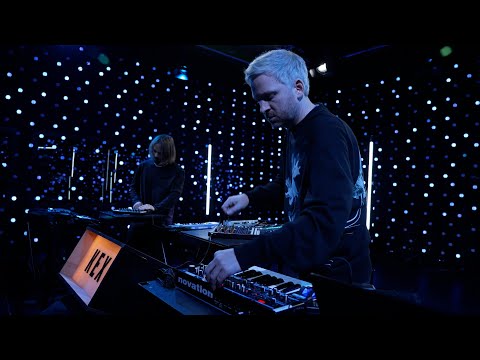
In 2009, Arnalds formed the experimental techno project Kiasmos with Janus Rasmussen—a producer born in the Faroe Islands and based in Reykjavík, and a member of the Icelandic electro-pop band Bloodgroup.
Kiasmos inhabits a world clearly distinct from Arnalds' solo work. Ambient atmosphere drifts above techno beats; the border between club music and post-classical is deliberately dissolved. The chemistry between a man who came to post-classical through metal drumming and a man rooted in electro-pop produces something singular: ambient techno that feels as though it might be danced to, yet always seems to be looking somewhere far away.
The Other Pole: Janus Rasmussen and the Aesthetics of Subtraction
Kiasmos cannot be dismissed as Arnalds' side project. What kept it from becoming mere “club music with strings draped over it” is the presence of Janus Rasmussen.
Where Arnalds approached beats from the context of chamber music, Janus began his career in pure electronic music and electro-pop. His solo albums Vín (2019) and the more ambitious Inert (2026) reveal an artist with exceptional control over the space between sounds. On Inert, he incorporates his own vocals more than ever before, drawing new energy from across the dance music spectrum while retaining the subtle restraint that has defined his work.
Janus' brand of minimal techno is characterized by a stripped-back, acoustic-feeling texture and a cold yet quietly melancholic electronic design. That meticulous attention to detail and precision in sound design met Arnalds' lyrical piano melodies.
Arnalds crossing over from the classical side, Janus drawn in from the electronic side: Kiasmos is the inevitable product of two people starting from different places and converging on the same destination—a place of stillness.

What Connects Them: The Freedom of an Island That Knew No Genre Walls
Neither Jóhannsson nor Arnalds received formal conservatory training. As Arnalds himself has noted, because virtually no music industry infrastructure exists in Iceland, its musicians carry a fearlessness about leaping over creative barriers. Placing the sounds of a discarded computer alongside a string orchestra, or a former metal drummer developing algorithms for self-playing pianos—both of these acts emerge from a freedom to move before asking whether one is allowed to.
That freedom is, perhaps, the source of the distinctive lightness in their music: neither the weight of academic seriousness nor the calculation of pop, but the direct product of an instinct for how music ought to feel.
The Dense Network of a Small Island: A Substitute for Formal Education
In an interview, Arnalds put it plainly: “If you're doing music, you kind of know everyone else who is doing music. There is no competition. Because you're not competing for anything. There is no real music business there. You can't make any money. You can't get famous.” In Iceland, where a music industry barely exists, musicians are unusually close to one another.
The most important relationship born from this closeness—for Jóhannsson—was his friendship with the classical cellist Hildur Guðnadóttir.
Jóhannsson and Hildur: Thirty Years That Began with Kitchen Motors
In 1999, Jóhannsson co-founded Kitchen Motors—a think tank, arts organization, and music label based in Reykjavík, designed to draw together people from across the divides of punk, jazz, classical, metal, and electronic music and generate new hybrids between them. Jóhannsson himself described it this way: “We tried to amplify the opportunities that already existed, pulling together people from the worlds of jazz, classical, electronic music, punk and metal to encourage new hybrids. My own music grew out of those experiments.”
It was through Kitchen Motors that Jóhannsson met Hildur Guðnadóttir. Hildur studied cello at the Reykjavík Music Academy, then composition and new media at the Iceland Academy of the Arts and the Berlin University of the Arts—a classically trained musician who would go on to win an Oscar, a Grammy, an Emmy, and a BAFTA. She and the self-taught Jóhannsson built a deep friendship in the late 1990s.
There were periods when the two shared a studio in Berlin. On Jóhannsson's film scores—Sicario, Arrival, Mary Magdalene—Hildur participated as cellist and co-composer. Of Jóhannsson, she has said: “We met in a completely non-verbal place. Our souls got tangled together, and stayed tangled together to this very day. We grew together.”
The image of a self-taught composer and a classically trained cellist complementing each other in the world of international film music embodies what is most characteristic about Iceland's music community: regardless of genre or educational background, those who resonate musically simply find each other.
Arnalds and the Erased Tapes Network
For Arnalds, what stood in place of formal education was the community formed around the Erased Tapes label. His relationship with the German pianist Nils Frahm is the clearest example: from 2012 onward, the two spent countless hours in improvised sessions across studios in Berlin and Reykjavík, producing multiple collaborative releases. Frahm is a classically trained composer, and in their improvisations the differences between them generate a productive friction rather than conflict.
Arnalds' 2016 project Island Songs extended this further still—over seven weeks, he traveled to seven locations across Iceland to co-write a new composition with a different local collaborator each week, connecting directly with performers from Iceland's choral traditions and poetry culture. The arc of a former metal drummer finding his way into Iceland's deeper musical intelligence is captured in the project itself.
Reflection: What “Smallness” Made Possible
Why do Jóhannsson and Arnalds, neither of them formally trained in classical music, nonetheless command orchestral language with such precision? Part of the answer may lie in Iceland's closed musical community. In an island nation of 350,000 people, a self-taught composer from the world of electronic music finds himself sharing rooms with classical musicians as a matter of daily life—and their respective languages seep in through proximity rather than instruction.
Learning not from a degree program but from the person beside you: Reykjavík may have functioned as exactly this kind of organic musical education. The almost thirty-year relationship between Jóhannsson and Hildur, and the ongoing improvisations between Arnalds and Frahm, both support that reading.