The Genius Jazz Pianist Who Left Too Soon: Esbjörn Svensson Trio
I still remember the moment a track came through the speakers of BBC Radio 3's Late Junction. It was a jazz piano trio, yet it had the texture of electronica. The beat was played on a live drum kit, yet it had a mechanical precision. The bass occasionally growled like a guitar. I had never heard jazz that sounded like this. The next day, I went out and bought the CD. That was my introduction to the Esbjörn Svensson Trio — e.s.t.
Three Musicians, Three Musical Worlds
E.s.t. was a Swedish jazz piano trio formed in Stockholm in 1993. The members were Esbjörn Svensson (piano), Dan Berglund (double bass), and Magnus Öström (drums).
Svensson and Öström were childhood friends. They grew up together in the small Swedish town of Västerås and had been playing in bands together since their teens. Svensson's musical origins spanned both classical music and jazz: his mother was a classical pianist, his father a jazz enthusiast. He grew up listening to rock on the radio, loved Thelonious Monk, and drew from an unusually wide range of influences. One of the tracks the band worked on during rehearsals went by the working title “Radiohead-Melody” — a detail that speaks for itself. Svensson said of it plainly: “All three of us love Radiohead.”
Öström's path to the drums began with his older brother's record collection: Jimi Hendrix, Deep Purple, the Allman Brothers, Lynyrd Skynyrd. A boy who trained his ears on rock, he was thirteen when he attended a concert by Billy Cobham and John McLaughlin and discovered jazz-rock. That experience became the foundation of everything he would do as a drummer.
Berglund was a committed hard rock fan to his core. As he described it himself: “I started to experiment with the bow and distortion on the bass, to sound like Jimi Hendrix or Ritchie Blackmore.” His bass was an unconventional instrument in any jazz context. After forming Tonbruket following e.s.t.'s end, he put it directly: “Since we have a guitarist in this band, I no longer have to be both bassist and guitarist, as I was at times with e.s.t.” The bass in e.s.t., in other words, had been doing the work of a guitar as well.
The Sound That Human Bodies Made
What made e.s.t.'s sound unlike anything else was the result of these three different musical backgrounds colliding and fusing.
Öström used the tips of brushes on his snare to imitate the feel of pop rhythm samples, and incorporated electronic triggers to expand his sonic palette. That quality — a live drum kit with the precision of programmed beats and the organic fluctuation of a human performer — came from a percussionist who had trained his ears on rock, awakened to jazz-rock, and then set out to reproduce the grid-like feel of electronica with his own body.
Berglund ran his double bass through distortion, fuzz and delay pedals, and sometimes bowed it to make it sing like a guitar. This approach — unorthodox by any jazz standard — gave e.s.t.'s music its rock-derived texture and forward momentum.
And then there was Svensson's piano. Playing with the structural logic of classical music, the spontaneity of jazz improvisation, and the melodic sensibility of pop, he landed unmistakably as a jazz pianist on top of whatever “non-jazz” thing Öström and Berglund were building beneath him.

How Live Performance Set the World on Fire
E.s.t. had been celebrated in Sweden from early on, but their international breakthrough came in 1999 at the ACT World Jazz Night at the Montreux Jazz Festival. From that point, ACT began releasing their albums outside Scandinavia, and the band expanded their reach across Europe.
Their strategy was relentless live performance. They spent nearly a hundred days a year on tour, playing not only jazz clubs but rock-oriented venues. Their use of elaborate lighting and fog machines on stage was a conscious effort to reach younger audiences beyond the traditional jazz crowd.
In London, they started at the small Pizza Express Jazz Club on Dean Street and steadily built their audience until they were filling concert halls. Late Junction and other adventurous radio programmes provided an important route to listeners outside the jazz world during this period.
Their 2002 album Strange Place for Snow won numerous prizes — among them the German Jazz Award and the Victoire du Jazz (France's equivalent of the Grammy) for best international act — bringing e.s.t.'s name to audiences across Europe. In 2006, they became the first European band ever to appear on the cover of the American jazz bible Downbeat.
The Live Recording That Captures the Miracle: Live in Hamburg
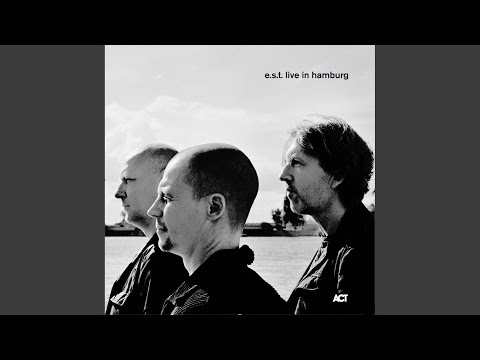
The proof that e.s.t. had reached their absolute peak is preserved in Live in Hamburg, recorded in November 2006 at the Laeiszhalle in Hamburg. It was made roughly eighteen months before Svensson's death, at the moment when the three musicians were playing with the greatest freedom and daring of their careers. The improvisational breadth that no studio album could quite contain, and the miracle of three musicians generating a groove as one — it is all here.
The Completed Vision: Seven Days of Falling
The 2003 album Seven Days of Falling is where e.s.t.'s sound reached its fullest realisation. Electronica, jazz and rock fused completely, crystallising into something that belonged to no genre.
On this album, Öström's drumming pursued the “programmed” quality more boldly than ever, while Berglund's bass moved even more freely across the boundary between bass and guitar. Svensson's piano sustained its melodic beauty while concealing increasingly complex rhythmic structures beneath it.
It was around this time that critics began describing e.s.t. as “the gateway through which people who had never liked jazz discovered they could.” The trio was selling three times the usual volume for a jazz release, and audiences who had never set foot in a jazz venue were filling their concert halls.

A Comparison: Nils Petter Molvær and the Difference That Matters
A Norwegian trumpet player who is sometimes discussed alongside e.s.t. is Nils Petter Molvær. ECM Records had long been known as a label synonymous with quiet, contemplative chamber jazz — and Molvær overturned that reputation with Khmer in 1997 and Solid Ether in 2000. The latter album brought programmed beats even more to the foreground: its opening track, “Dead Indeed,” was almost entirely played and programmed by Molvær himself. Both records received critical acclaim well beyond jazz circles and opened ECM to new audiences.
But there is a fundamental difference. Molvær operates a computer and sampler himself, layering his trumpet over electronically generated beats. It is a distinctive and accomplished approach — but its starting point is different from e.s.t.'s.
What e.s.t. created was the result of human bodies attempting to imitate the grid of electronica and then surpass it. Without a machine in sight, three musicians on acoustic instruments fused jazz, rock and electronica together through sheer physical performance. That was the miracle they made with their bodies.
The Sudden End
On 14 June 2008, at the height of their powers, Svensson went missing during a scuba diving session off the island of Ingarö near Stockholm. He was 44. His diving companions — including his fourteen-year-old son — found him unconscious on the seabed.
Berglund and Öström decided that continuing the band with a different pianist was not something they could do. E.s.t. ended there.
Both have continued making music in other projects. Berglund formed Tonbruket; Öström pursued a solo career before launching Rymden. But e.s.t. as a band no longer exists.
A Miracle No One Has Surpassed
Musicians who came after e.s.t. took something from their sound and tried to carry it into their own music. But no one has managed to rebuild the house completely.
The sound of electronica, rock and jazz fused through nothing but live drums, live bass and live piano was a chemical reaction produced by three musicians with singular backgrounds and years of shared ensemble experience. It cannot be reproduced.
Listening to albums made more than twenty years ago, e.s.t.'s sound has not aged. That is not because their music was riding the wave of a particular genre or era. It is because they touched something at the limit of what human bodies and acoustic instruments can do.
That miracle has not been surpassed.