Taming Danger Into Architecture: Nico Muhly and the Musical Ideal Embodied in Bigger & Closer
Music is something that holds the rigor of structure, like architecture, and creates a space that puts the person standing inside it at ease. This is my definition of music. Not the expression of emotion or the depiction of a scene, but the construction of a sequence of ordered tension across time. Standing on this definition, I don't think any work embodies it more fully than the score Nico Muhly wrote for David Hockney: Bigger & Closer (Not Smaller and Further Away).
Why do I think this way, and why does this particular work look, to me, like the ideal's point of arrival? Let me walk through it.
I. Theory — Why Music Is Not the Expression of Emotion
The moment a single line is drawn on a canvas, a tension is born in that space. Draw a circle, and a new tension arises between the line and the circle. Abstract painting is the state in which this tension stabilizes without collapsing.
The same thing happens in time. The instant a note sounds, our ears begin waiting for the note that hasn't sounded yet — and that act of waiting is itself a line the sound draws through time.
This is where music and ambient sound part ways. Rain, wind — they carry no structure of expectation for what comes next. They generate no tension; they are mere duration. Music, by contrast, orders the relationship between sounds across time so that the listener's ear is continuously generating the tension of “this should come next.” It is this ordered chain of tension that makes music music.
Which is why I don't think music expresses an individual's emotions or scenery. Music as an outpouring of feeling doesn't design in the presence of a listener. Sound written only toward the composer's own interior is, put bluntly, self-absorbed — there's no room built in for anyone else to enter. The music I have in mind, instead, constructs this temporal tension with order, so that it becomes a “space” designed to hold the person standing inside it. To be a space at all, it must presuppose that someone will stand there. This is the same structure by which architecture is designed around the person who will live in it.
This definition is consistent with how I've written about music on this blog before. I made the same argument, for instance, in the piece on Jeff Buckley. His voice doesn't function as a confessional outpouring of emotion — it functions like furniture or a plant placed within the sturdy foundation of rock: solid rhythm, solid harmony. The foundation itself never buckles; it holds the space, and within it, the voice is placed as a color, giving the whole space life. It's precisely because rock's foundation has that strength that the voice can register not as an emotional overflow overwhelming the listener, but as one element enriching the space.
Nico Muhly's music is governed by the same principle — a design philosophy of placing colors that embrace the listener atop a sturdy structure. As recent work in music cognition suggests (studies on the Tsimané people of the Bolivian Amazon, 2016, among others), the very fact that our ears find “harmony” comforting is itself a cultural construction, built up over time rather than given at birth.
II. Speaks Volumes — When the Danger Was Still Exposed
Muhly's musical origins pull from two seemingly opposite poles. He has said, repeatedly, in interviews, that his formative influences were “American minimalism (Reich, Glass)” and “English Renaissance choral music (Byrd, Gibbons, Purcell).” The repeating pulse of minimalism and the independent voices of Renaissance counterpoint — holding both at once is what separates his music from a simple minimalist follower.
In 2006, at 25, Muhly released his debut album Speaks Volumes, and on it, these two poles still collide, raw and unresolved. “Pillaging Music” leaps from place to place and ends about as chaotic as it began. Even at the production level, raw electronic sounds — something like the crackle of static electricity or ball bearings rolling inside a ceramic bowl — are mixed directly into the performed sound. This is a stage where the danger of “will this actually stand?” is presented plainly, without restraint.
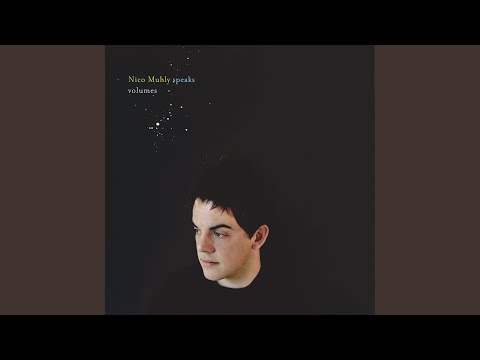
This danger recalls the early Zaha Hadid — the era of The Peak, the competition she won but never saw built, the era of those drawings that looked like “shattered fragments.” For Hadid, that danger became real architecture in 1993, with the Vitra Fire Station, through the invisible technology of three-dimensional structural analysis. I think, for Muhly, the equivalent of that “structural analysis” is counterpoint. The unpredictable collisions between voices are, in fact, governed by the rules of counterpoint. The danger is audible; the rigorous calculation underneath it is not. That separation is the shared structure of beauty in both.
III. Bigger & Closer — Danger Restrained, Architecture Purified
The score Muhly wrote for David Hockney: Bigger & Closer, premiered at Lightroom in London in 2023, has that danger largely reined in. Scored for a chamber ensemble — piano/celesta, string quartet, flute/piccolo — pieces like “Perspective Lesson” and “Drawing with a Camera” carry almost none of the unpredictable leaps or collisions that marked Speaks Volumes. It lands somewhere more listenable, more consonant.
But that doesn't mean the music has been simplified. Here, Muhly lays the repeating pulse of minimalism down as beam and column, and builds the independence of contrapuntal voices on top of it. The pulse guarantees the predictability of “the same shape will recur,” letting the listener stand securely inside the space. The counterpoint, meanwhile — each voice moving by its own independent logic — brings a complex mechanics of distributed load into that stable structure: not mere monotonous repetition, but the strength of a structure whose parts hold each other up.
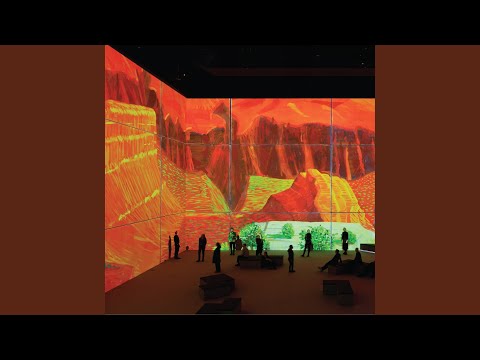
It's the simultaneous operation of these two things that lets my ideal — “a space designed to hold the presence of the listener” — take shape as structure for the first time. Minimalism alone is just uniform, tedious repetition. Counterpoint alone is a dangerous maze that leaves the listener behind. I think Muhly restrained, here, the danger he put on display in his debut precisely because combining these two techniques deliberately was the way toward a more complete kind of rigor: an architecture that holds danger inside it while still putting people at ease.
That, too, resonates quietly with Hockney's own artistic project — his resistance to single-point perspective, “the one correct viewpoint,” and his attempt to fix multiple viewpoints into a single image. Independently moving voices, in counterpoint, are the musical translation of exactly what Hockney attempted with camera and canvas: the simultaneous presence of multiple viewpoints. Many viewpoints held together without collapsing — that is the great sense of ease this music offers.
Coda
There are countless definitions of music. But by the measure of whether it is designed to hold the presence of a listener, Bigger & Closer — restraining its own danger, moving toward a purer construction — marks one critical point of music that refuses to be self-absorbed.
A rigorous skeleton of minimalism, and the complex mechanics of counterpoint. By deploying both deliberately, Nico Muhly achieves something like architecture in music — not by erasing the danger, but by taming it.