You've Already Heard It: The Forgotten Name of Penguin Cafe Orchestra
One day, a piece of music drifting out of BBC Radio 3's Late Junction made me stop what I was doing. Strings and guitar dancing around each other in an interplay unlike anything I'd heard before. I jotted down the song title and the band name, and started working my way through their albums. Then, somewhere deep into that listening, a melody came on that I recognized — the one I'd been hearing in HP commercials for years.
Penguin Cafe Orchestra. I had been living with their music for years before I ever learned their name.
“You know it, but you don't know whose it is.” That's what Penguin Cafe Orchestra has always been.
Music Born from a Fever Dream
To talk about Penguin Cafe Orchestra, you have to start in the south of France in 1972. British guitarist Simon Jeffes ate some bad fish and fell ill. Laid up in bed, burning with fever, he kept seeing the same strange vision.
Arthur Jeffes — Simon's son — later described it this way: “My father had a nightmare about the near future. People lived in enormous concrete buildings, staring at screens. In the corner of each room sat a large camera, watching them constantly. In one room, a couple was having loveless sex. In another, a musician sat surrounded by mountains of equipment — but wearing headphones, so no actual music filled the room.”
At the opposite pole of that inhuman world, Simon saw in his dream a place called the Penguin Cafe. Walking down a dark street, you'd come upon an old building spilling out light and noise. Inside, a long table where strangers sat shoulder to shoulder. And at the far end, a small ensemble playing — music that felt somehow familiar, yet impossible to place.
When the fever broke, Simon made a decision: he would write the music that dream ensemble was playing. And so, in 1972, Penguin Cafe Orchestra was born.
Chamber Music Called an “Orchestra”
The word Orchestra conjures images of a large symphonic ensemble. The actual Penguin Cafe Orchestra was something far removed from that — a small, intimate group.
Guitar, cello, violin, ukulele, trombone, percussion. The lineup shifted from piece to piece, and Simon brought in harmonium, penny whistle, rubber bands, and even telephone dial tones as instruments. This was chamber music — or something even freer than that, something that refused any category.
The name Orchestra was Simon's joke, and also his musical manifesto. He borrowed a word with authoritative weight and quietly dismantled what it implied. Not music to fill a concert hall, but music to be played in the back of a café — intimate, warm, bodily. That was what Simon was after.
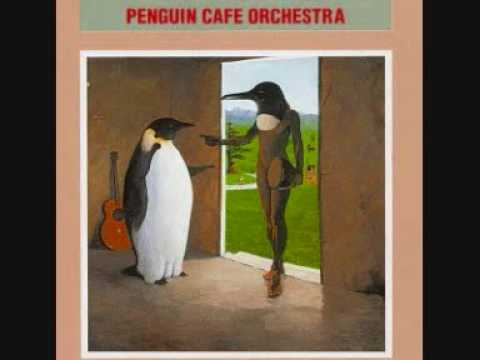
“Perpetuum Mobile” (1987). Written in the irregular meter of 15/8, this piece carries the sensation of a perpetual motion machine that seems always about to end but never does. It became widely known as the theme for the TV adaptation of The Handmaid's Tale and the film Mary and Max.
The Music of Its Moment, and Something Distinctly British
When Penguin Cafe Orchestra released their debut album in 1976, they were emerging from — and in conversation with — a rich landscape of contemporary music.
In America, Steve Reich and Philip Glass were developing Minimalism: repeating patterns, layered voices, quiet transformation. PCO's music shares structural affinities with all of that. But it keeps a clear distance from Minimalism's abstraction and cool detachment.
Where contemporary Minimalism pursued intellectual structural beauty and rigorous systems, PCO's music is shot through with an irrepressible sense of play. Rubber bands as instruments. Telephone dial tones looped into a piece literally called “Telephone and Rubber Band.” Odd time signatures and intricate counterpoint that, in Simon's hands, read not as complexity but as humor. He borrowed Minimalism's language and then let the air out of its tension — that was Simon Jeffes's particular genius.
Part of the source of that playfulness, I think, lies in British and Irish traditional music. Trad has long been built around the repetition of short phrases for dancing — reels and jigs, melodies cycling with small variations. The repetition that Minimalism pursued intellectually was already embedded there, in the body, in the feet. PCO brought both kinds of repetition together not as an academic proposition but as physical joy.
The origin story of “Music for a Found Harmonium” is emblematic. On a Japanese tour, Simon happened upon an old foot-pedal organ abandoned by the roadside. The simple melody that emerged from that imperfect instrument slipped so naturally into the grammar of Irish reels that traditional players — Patrick Street, De Dannan, Kevin Burke, Sharon Shannon — began covering it as if it had always belonged to them. Not classical music, not contemporary art music, but the music people have danced and laughed and made noise to across generations — that was what supported PCO's humor and lightness.
The debut album was released on Obscure Records, the label run by Brian Eno. Eno's ambient music proposed a static kind of space — music that could be listened to or ignored equally. Simon's vision was different: it contained the warmth and noise of people actually gathered together. PCO's music has that particular friendliness because, against Eno's depopulated atmosphere, it always carries the body heat of other people in the room. Meanwhile, Kraftwerk was inventing an entirely new musical language called techno. PCO shared in the same contemporary questions, and turned toward something more human, somewhere warmer.
The rhythmic vitality of folk, the structure of Minimalism, the atmosphere of ambient, the intimacy of chamber music — all of it dissolved into a distinctly British lyricism. None of Philip Glass's chill, none of Eno's self-erasure, none of Kraftwerk's mechanization. Something more human, more frayed at the edges, and funnier.
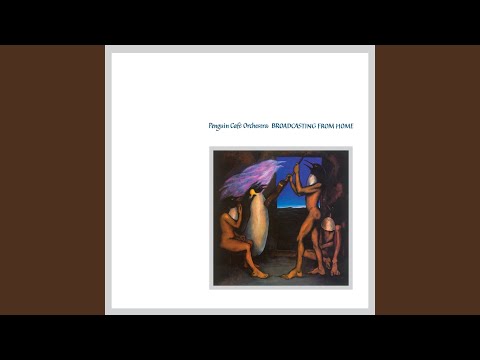
“Music for a Found Harmonium” (1984). Inspired by a foot-pedal organ Simon discovered abandoned on a street. The melody was adopted by Irish traditional musicians as their own, and was later featured in the film Napoleon Dynamite.
Success, Forgetting, and Ubiquity
Penguin Cafe Orchestra were never obscure. The 1987 album Signs of Life charted in the UK, and they toured internationally. They found an audience in Japan. The Royal Ballet incorporated their music into productions. They appeared on The South Bank Show and on Terry Wogan's television programme.
But their debut came out in 1976 — the year I was born — and that music is now “old.” Streaming algorithms favor new releases. And Simon Jeffes died in 1997, of a brain tumor, at forty-eight. There would be no new music, no new tours.
Still, the music kept living. As film scores, as television soundtracks, as background music in commercials. HP was only the most prominent of countless advertisements. The Handmaid's Tale, Mary and Max, Napoleon Dynamite, Capitalism: A Love Story — the list of screen works drawing on PCO is long.
This is how the “you know it but you don't know whose it is” phenomenon works. The music continued to reach people's ears through different circuits even after the name faded from common knowledge. Only the name was left behind as time moved on.
What the Son Inherited
Ten years after Simon's death, in 2007, former members gathered at Union Chapel in London for a memorial concert. On that stage, Simon's son Arthur Jeffes played percussion and keyboards. All three nights sold out.
Encouraged by that response, Arthur formed a new band in 2009 called simply Penguin Cafe — a completely new ensemble, with none of the original PCO members.
Arthur studied archaeology and anthropology at Cambridge — an intellectual by formation — while also nurturing a passion for experimental music. There's a story from his childhood of him striking piano keys with a hammer, which Simon apparently read not as destruction but as the first stirrings of an experimental spirit.
Penguin Cafe has now released five albums, every one of them on Erased Tapes — the post-classical label that has been home to Nils Frahm, Ólafur Arnalds, and Jóhann Jóhannsson. That fact alone signals that Arthur is not simply preserving Simon's legacy, but actively situating Penguin Cafe within the contemporary conversations of post-classical and neo-classical music.

In the repeating structures and unique sense of play that animate Penguin Cafe, the weight of his father's influence is not hard to find.
Still Playing, in the Back of the Café
The latest album, Rain Before Seven… (2023), represents the current horizon of Arthur's Penguin Cafe. Its title draws from an old British weather saying — “Rain before seven, fine before eleven” — and the music carries Simon's spirit forward while speaking in Arthur's own voice.
Violin, cello, double bass, percussion alongside balafon, ukulele, melodica. Just as Simon made rubber bands and telephone tones into instruments, Arthur brings “unexpected sounds” into the chamber music frame. The approach is faithful throughout to his father's philosophy: “Take an interesting, slightly weird idea and do something weird with it. But make it beautiful, and emotionally accessible.”
The dream café is still open. The ensemble in the back is still playing. And you have almost certainly already heard them. You just didn't know their name.