The Voice That Speaks Directly to You: Natalie Merchant's Journey
Words Came Before the Music
Natalie Merchant was born in 1963 in Jamestown, New York. Her parents divorced when she was seven, and after her mother remarried, the family moved to a commune in upstate New York. The women she met there became the foundation of who she would become.
“I fell in love with those people,” she has said. “They were artists. They were ladies that didn't shave their legs. They lived alone and fed the wood stove in the winter, and they were strong.”
She grew up in a house without television. At sixteen, she dropped out of high school and enrolled in community college. Outside the classroom, she read books and discovered folk music — picking up a copy of Harry Smith's Anthology of American Folk Music from the library was the door that led her to singing. It wasn't hours of guitar practice that shaped her; words and reading came first. Her eye for people pushed to the margins of society was already forming in those years.
10,000 Maniacs — The Band's Voice, Her Own Words
In 1981, seventeen-year-old Natalie joined a Jamestown band called Still Life. The band soon renamed themselves 10,000 Maniacs, and Natalie took on the roles of lead vocalist and primary lyricist.
From her teenage years, her songwriting stood apart. Forgotten figures from history, the guilt of a bystander watching a child be abused (“What's the Matter Here”), an unwanted pregnancy (“Eat for Two”) — the practice of using pop songs as a vehicle for social and historical subjects was there from the very start of her career, and it never left.
The band hit their peak between 1987 and 1993, with In My Tribe, Blind Man's Zoo, and Our Time in Eden all charting in the top tier of the US charts. At their 1993 MTV Unplugged session, they covered “Because the Night,” the song co-written by Bruce Springsteen and Patti Smith. Natalie's intimately conversational delivery made the cover the band's biggest hit, reaching No. 11 on the Billboard Hot 100, and brought her name to a much wider audience.
That same year, she announced she was leaving. Her stated reason: a lack of creative control over the music she wrote. She chose to break free from the machinery of a band that had grown large around her and to stand entirely on her own as a singer-songwriter.
Patti Smith's original (written by Bruce Springsteen)

10,000 Maniacs' cover

Tigerlily — A Voice Written in Complete Freedom
Her 1995 solo debut Tigerlily was the first album Natalie made with total creative freedom.
The result was stunning. “Carnival,” “Wonder,” and “Jealousy” charted on the Billboard Hot 100 in succession, and the album went on to sell over five million copies. But the commercial success gave Natalie something beyond fame — it gave her the financial and psychological independence to spend the rest of her career ignoring label pressure and pursuing social activism and artistic experimentation entirely on her own terms.
“Wonder,” in particular, was written as a tribute to twin girls Natalie had come to know personally, both born with epidermolysis bullosa (EB), a rare and painful genetic condition that causes the skin to blister at the slightest contact. Natalie has said she didn't know who the song was about when she wrote it — she discovered the twins afterward, formed a deep friendship with them, and stayed close until they died in their twenties. The song's universal message later inspired R.J. Palacio's YA novel Wonder, and was played over the end credits of the 2017 film adaptation.
The success of “Wonder” was no accident. The same gaze she had learned from the strong women of the commune — a way of seeing people the world had pushed aside — was what moved audiences. As a rare example of an artist who achieved both artistic integrity and commercial success simultaneously, Tigerlily remains the defining album of Natalie Merchant's career.
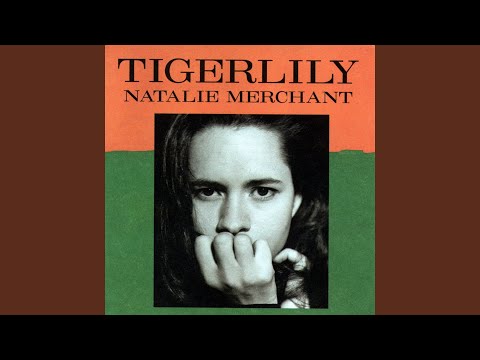
“Wonder” (1995, from Tigerlily). Written as a tribute to twin girls born with epidermolysis bullosa (EB). Its universal message inspired R.J. Palacio's novel Wonder and was used in the end credits of the 2017 film of the same name.
Poetry and Politics — A Maturing Voice
After going solo, Natalie moved steadily away from chart positions and toward the music she actually wanted to make.
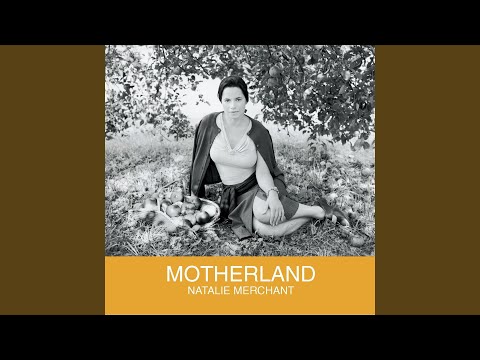
Motherland (2001) brought her political and social consciousness to the foreground, and Leave Your Sleep (2010) saw her set the poems of various poets to music — an unconventional project by any measure. The freedom that Tigerlily's success had created made these uncommercial artistic experiments possible. She drifted from the mainstream, but her influence can be heard clearly in the generation of thoughtful singer-songwriters that followed — Colin Meloy of The Decemberists, Weyes Blood, and others who share her instinct for literary, socially conscious songwriting.
The album's title track, “Motherland,” is a desperate prayer to be held and sheltered from the encroaching concrete of modern life. Its repeated refrain — a plea to be cradled, lulled to sleep, kept safe — reads not as simple nostalgia but as a direct confrontation with the alienation of contemporary society. The song was completed just days before September 11, 2001. Merchant later said: “I was far more cynical when I wrote it. But now the song has become the death of nostalgia and dreams.” An act of violence rewrote the meaning of a song she had already finished — and that fact alone speaks to how wide a net her writing casts.
🔗 Read the full lyrics to “Motherland” on Genius
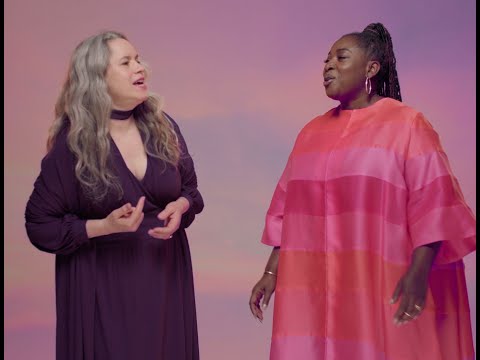
On “Big Girls” from Keep Your Courage (2023), a duet with Black vocalist Abena Koomson-Davis, she sings of women holding each other up through the storm. Her eye for those pushed to the margins has not dimmed past sixty.
Losing Her Voice, Finding It Again
In 2019, Natalie was visiting the V&A Museum in London when her arm suddenly went numb. Back home, tests revealed she had OPLL (ossification of the posterior longitudinal ligament) — a degenerative spinal condition in which the ligaments of the spine calcify and compress the spinal cord, potentially leading to paralysis in severe cases. Emergency surgery was unavoidable.
The operation lasted six hours. Surgeons made an incision in her throat, moved her vocal cords aside, and removed three bones from her spine. When she came around, she couldn't sing.
“It took me to a place of panic,” she has said. “It made me wish I had made more records.”
For ten months, her voice didn't return. While that silence stretched on, the pandemic closed over the world. Natalie found a collection of poetry by Robin Robertson, and words began to move through her throat again. She started writing songs. The result was Keep Your Courage (2023).
Peter Asher, who had produced her work years earlier, said: “I've been a fan for decades, but this might be her greatest album.” The chart numbers don't match the heights of Tigerlily's commercial peak. But in an album made after losing her voice, getting it back, and turning sixty, there is something that no chart position could measure.
“Keep Your Courage” (2023). Her first collection of original songs in nine years, born from the silence of spinal surgery and the solitude of a pandemic.
The Gaze That Never Changed
Her voice has aged. But the core of how she sings has not.
The style of speaking directly to the listener, the eye for those the world has pushed aside, the ability to fold feminism and social consciousness into music people actually wanted to hear — all of it has been there since the day a seventeen-year-old walked into a Jamestown band rehearsal, and none of it has left.
A girl who dropped out of high school, was shaped by the strong women of a commune, and found her way into music through a library record collection has been speaking to the world for over forty years. Is there a voice like that in your own life — one that has never quite changed?