The Saxophone That Sings Early Music : Jan Garbarek
Description: The saxophone was invented in the 1840s—yet in the hands of certain performers, it can sing Renaissance polyphony with an almost human intimacy that period instruments can't quite achieve. This piece pairs that strange anachronism with the story of a medieval songbook that survived purely by accident—sealed inside a convent wall and rediscovered centuries later. Two improbable survivals: a repertoire that was nearly lost, and an instrument that wasn't supposed to play it. What happens when they meet is unexpectedly moving.
The Origin of an Encounter — In the Icelandic Wilderness
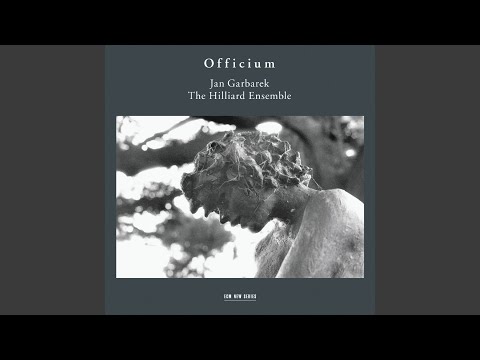
In 1991, ECM Records founder Manfred Eicher was shooting a film in Iceland — an adaptation of a Max Frisch novel. Amid that desolate lava landscape, he found himself returning again and again to a particular combination: the sacred choral music of Spanish Renaissance composer Cristóbal de Morales, and the improvisations of Norwegian saxophonist Jan Garbarek.
Different genres, different centuries. And yet, within the same space of the Icelandic wilderness, those two musics resonated with a strangeness that felt entirely natural. Carrying that conviction, Eicher brought Garbarek and the Hilliard Ensemble together at St. Gerold Monastery in Austria in 1993.
That afternoon, three or four minutes into the Hilliard Ensemble's performance of Morales's Parce mihi Domine, Garbarek quietly picked up his saxophone and joined in without a word. Everyone played to the end in a kind of stunned silence, and when the music stopped and the quiet descended, Eicher — his eyes wet with tears — said: “We must record this immediately.”
In 1994, the album Officium was released.
Who Is Jan Garbarek
Born in 1947 in Mysen, Norway. At fourteen, he heard John Coltrane on the radio and resolved then and there to play the saxophone. He taught himself by imitating Coltrane, won an amateur contest in 1962, and went on to study with American composer and theorist George Russell — becoming the face of ECM Records from the label's very first release, his 1970 debut Afric Pepperbird.
Garbarek's saxophone voice is unmistakable: a sharp-edged tone that stretches into long, sustained notes — sometimes likened to the call of Islamic prayer. But at its foundation lies a deep connection to Norwegian folk music. Triptykon (1972) was his first work to incorporate Norwegian folk melodies, a direction encouraged by American trumpeter Don Cherry. “I am tied to a particular vocabulary and phrases linked to Norwegian folk music,” Garbarek has said.
When he plays Norwegian folk melodies on tenor saxophone, his microtonal pitch bends recall the gradual movement of an Indian raga — not the equal-tempered intervals of jazz, but the subtle inflections of a singer bending a note with their voice. It is a saxophone, and yet something vocal inhabits it. This approach was precisely the key that made the chemical reaction with the Hilliard Ensemble's vocal polyphony possible.
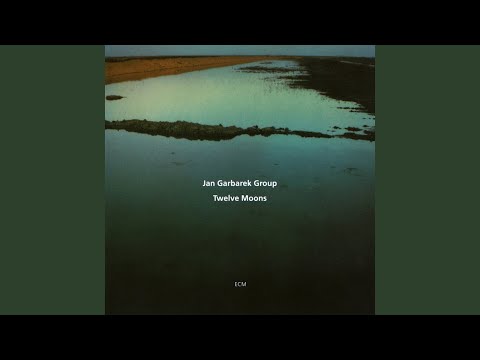
Garbarek's musical world extends far beyond the frame of a jazz saxophonist, crystallising into a form of “composition” deeply rooted in his own identity and Nordic origins. One clear expression of this is the 1993 album Twelve Moons, where he reconstructs the traditional songs (joik) of the Sámi — the indigenous people of his homeland — alongside motifs from fellow Norwegian composer Grieg, reshaping them through his own vocabulary into richly original works.
Who Is the Hilliard Ensemble
A British male vocal quartet founded in 1974, taking their name from Elizabethan miniaturist Nicholas Hilliard. Specialists in medieval and Renaissance music — from Gregorian chant to sixteenth-century polyphony — they were also active advocates for contemporary composers such as Arvo Pärt, and maintained a long relationship with ECM Records.
The ensemble comprised countertenor David James, tenors Rogers Covey-Crump and John Potter, and baritone Gordon Jones. They concluded their forty-one years of activity in 2014.
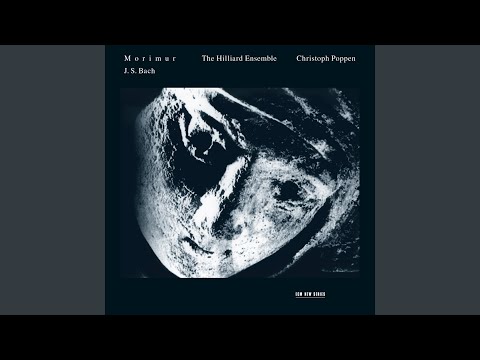
Bach left behind a vast body of church music throughout his life. The Chaconne appears at first glance to be a work for solo instrument alone — yet it is said that encoded within its intricate melodic lines, like a hidden cipher, is a sacred chorale written as a prayer for his deceased wife. The Hilliard Ensemble, that authority on early music, breathes entirely new life into this celebrated work by laying those concealed voices over it.
Why the Saxophone “Sings” — Three Reasons
1. The Pitch Inflections of Folk Music
Garbarek does not sound a pitch as a fixed point. The sense of “bending a note like the human voice” — absorbed into his body from Norwegian folk performance practice — gives the saxophone line a quality of living voice. The modal scale structures of Renaissance vocal polyphony and this microtonal style of playing dissolve into each other naturally.
2. The Reverberation of the Monastery
The recording was made at St. Gerold Monastery in Vorarlberg, Austria. The long reverberation generated by that stone space envelops both voice and saxophone within the same acoustic environment, blurring the boundary between them. Garbarek's saxophone resonates as “a fifth voice,” breathing the same air as the four singers.
3. Pure Improvisation — Without a Score
Garbarek never looks at the Hilliard's scores. What he needs is simply “what key they're singing in — two sharps or two flats — that's all”; everything else he plays entirely by ear. His improvisation is not pre-constructed: it is a real-time dialogue responding to the emotions generated in the moment by the singers. That is why no two takes are ever the same, and why the saxophone's voice sounds like “a breath woven between the phrases of a song.”
Morales as Material
At the heart of the album stands Cristóbal de Morales (c. 1500–1553) — a composer born in Seville who served in the Papal Chapel in Rome for a decade, and the foremost figure of the Spanish Renaissance. His Parce mihi Domine (“Lord, have mercy on me”) is drawn from the Officium defunctorum — the Mass for the Dead — and its sombre, austere beauty lives on unchanged five hundred years later within the stone walls of a monastery.
It was no accident that Eicher, in the Icelandic wilderness, was listening to Morales and Garbarek simultaneously. Both shared the quality of “a thin melodic voice placed within a vast silence.”
A Second Miracle — The Cantigas de Santa Maria, a Folk Song That Did Not Disappear
If Officium represents an encounter between sacred chant and jazz, another recording poses a yet more fundamental question: why do songs sung by commoners and troubadours in thirteenth-century Spain sound “new” to our ears eight hundred years later?
The Miracle of Survival as Written Music
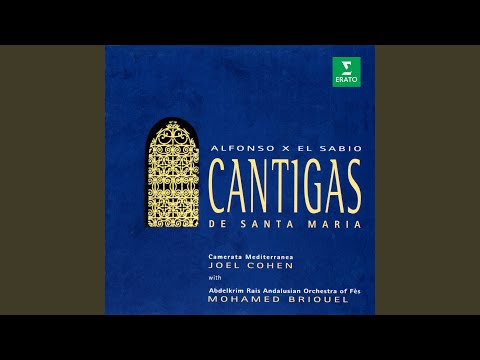
In October 1988, a recording session was held at the Mnebhi Palace in Fez, Morocco. Joel Cohen — American early music conductor and lutenist — led the Camerata Mediterranea alongside the Fez Andalusian Orchestra (conducted by Abdelkrim Rais) and Moroccan musician Mohammed Briouel, all gathered in one room. The repertoire was the Cantigas de Santa Maria — songs to the Virgin Mary assembled under Alfonso X (“the Wise”), King of Castile, in the thirteenth century.
What are the Cantigas? A collection of 420 poems and musical compositions written in medieval Galician-Portuguese, comprising hymns of praise to the Virgin Mary and accounts of her miracles. The vast majority of composers are unknown — songs created by Muslim, Christian, and Jewish poets, troubadours, and musicians who gathered at court, then collected and codified by Alfonso X under his royal authority. It is precisely because of that royal patronage that they survive today.
What matters is that these songs survive as written music. Four manuscripts still exist — two at El Escorial, one at the Biblioteca Nacional de España in Madrid, and one in Florence — each containing musical notation. Medieval notation differs substantially from modern practice, requiring specialist knowledge to decipher, but the melodic contour can at least be read. This is close to a miracle. Countless melodies sung among the nobility and common people of that era vanished as unwritten oral traditions. But the Cantigas were inscribed in manuscripts under royal patronage and have crossed eight centuries to reach us.
Convivencia — The Music Born of an Age of Coexistence
Thirteenth-century Spain — Castile and Andalusia in particular — existed in a rare cultural condition known as convivencia (“coexistence”): Christianity, Islam, and Judaism sharing the same spaces, their cultures intersecting. This situation carried complex tensions as the Reconquista advanced, but the court of Alfonso X functioned, at least, as a crossroads of that multicultural exchange.
The music of the Cantigas holds within it the modes of Gregorian chant alongside the microtonal colours of Arab-Andalusian music. Oud, qanun (a zither-type string instrument), and darbuka (a goblet drum) intertwine with the voices. This is Christian devotional music, yet it wears Islamic instruments and scales. That the 1988 Fez recording placed a European early music ensemble and Moroccan Andalusian musicians in the same room was also a re-enactment of that historical mingling.
Joel Cohen as Guide
Born in 1942 in Providence, Rhode Island. After studying at Brown University and Harvard — where he studied composition — he went to Paris to study with Nadia Boulanger. He became music director of the Boston Camerata in 1968 (serving for forty years, until 2008), and later founded the Camerata Mediterranea in 1990.
In America, Cohen is known primarily as the long-serving leader of the Boston Camerata; on the eastern side of the Atlantic, however, he is esteemed as a lutenist and master of accompanied song. His practice of playing the lute while conducting and singing connects directly to the troubadour tradition of medieval and Renaissance music-making. His work as a music producer for French national radio, his Edison Award (Netherlands), and his decoration as an Officier de l'Ordre des Arts et des Lettres in France attest to his international standing.
That the Cantigas recording received the Edison Prize 2000 confirms that this “ancient yet new” music was recognised at the highest level.
Why Does It Sound “New” Eight Hundred Years Later
That the Cantigas survived as written notation is a miracle of preservation — but that alone does not explain why they resonate as fresh to the modern ear.
One reason is the ambiguity of the decipherment. Medieval notation records rhythmic information only loosely, leaving performers a degree of interpretive freedom. This is music that lives between excavation and re-creation, not strict reconstruction.
A second reason is the modernity of hybridity itself. The sound world of the Cantigas — oud and lute, Arab percussion and European strings in conversation — resonates somewhere with contemporary world music and crossover sensibilities. And yet it is not a calculated “fusion” but the natural product of an era in which coexistence was simply taken for granted. It is precisely that unselfconsciousness that catches the modern ear off guard.
Melodies once voiced by nameless singers in the court of Alfonso X were breathed back to life by Moroccan and European musicians at the Mnebhi Palace in Fez, and arrive now at the ears of listeners in the 2000s. A slender thread of written notation has held that eight-hundred-year bridge in place.
On the Record
Officium appeared on not only classical charts but pop charts following its 1994 release, becoming the best-selling record in ECM history with over 1.5 million copies sold. Critics called the album “something with no name — neither jazz nor early music.” Hilliard member John Potter said: “What kind of music is this? We don't know. It is what happened when a saxophonist, a vocal quartet, and a record producer met and made music together.”
Over the following twenty years, approximately one thousand concerts were performed, and four follow-up albums were released: Mnemosyne (1999), Officium Novum (2010), and Remember Me, My Dear (2019).