The Renaissance Composer as Important as Bach — Guillaume Dufay
Look at Guillaume Dufay's surviving output by the numbers, and you run into something unexpected. Only seven complete cyclic masses survive in full. His secular chansons, by contrast, number anywhere from 59 to 87 depending on how you count. A composer whose reputation rests first on his masses was, numerically speaking, overwhelmingly a chanson composer. That fact is a small but solid thread to pull on if we want to reconsider who Dufay really was.
The Music That Shaped Dufay — English Counterpoint and Harmony
The cyclic mass — a setting of all five movements of the Mass Ordinary (Kyrie, Gloria, Credo, Sanctus, Agnus Dei) unified by a single cantus firmus — was first used systematically not by a continental composer but by composers in England. On top of that, a taste for sweet consonance centered on thirds and sixths had already existed in English music for some time. This wasn't something one person suddenly invented; it was a tendency rooted in English musical culture, and the composers most closely associated with actively putting it to use were John Dunstable and Leonel Power. Their music would later become known by the name given to this style: contenance angloise, the “English manner.” In other words, two elements — the cyclic mass as a form, and sweet consonance as a sound — had already taken root in England before Dufay.
The political situation at the end of the Hundred Years' War explains how this sound crossed over to the continent. England and the Duchy of Burgundy were allies for a long stretch beginning in the 1420s, and the Duke of Bedford, who served as regent of France for the English crown, maintained his own musical chapel in Paris. Dunstable is believed to have served under Bedford, and it was through this political crossing-point of England, France, and Burgundy that English musical language spread to the continent — particularly to the Duchy of Burgundy and its dependency, Flanders. Burgundy no longer exists as a state, but its territory consisted of its home base (roughly today's eastern France, centered on Dijon) and the Low Countries it acquired under Philip the Good (Flanders, Artois, Hainaut, Brabant, Holland, Zeeland, and more — spanning today's Belgium, the Netherlands, and Luxembourg). Cambrai, where Dufay grew up as a choirboy, sits in what is now northern France near the Belgian border — squarely within Burgundian territory.
This transmission is documented in the poet Martin le Franc's Le Champion des dames, written around 1441–42 and dedicated to Philip the Good, Duke of Burgundy, himself. It records, as a contemporary account, that Dufay and Binchois became fine composers by absorbing Dunstable's “English manner” — a style that flourished above all at the Burgundian court under Philip the Good's reign.
Ensemble Unicorn Gives Voice to the Secular Dufay
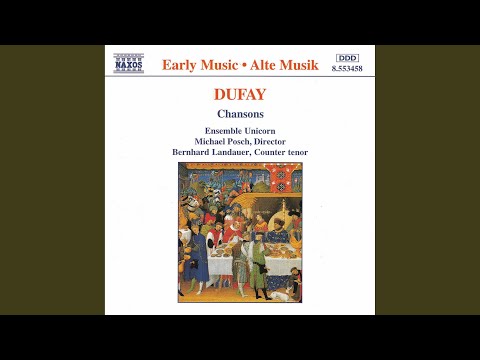
You can hear the concrete reality of the secular songwriting that fed Dufay's own musical bloodstream on Dufay: Chansons (Naxos 8.553458, with countertenor Bernhard Landauer, conducted by Michael Posch, Ensemble Unicorn, 1996). The first thing that strikes the ear is that nearly half of the album's seventeen tracks are purely instrumental. Even on the sung tracks, the two lower voices are carried by recorder, keyed fiddle, hurdy-gurdy, oud, and harp — solo voice and instruments dissolving into one another. Fifteenth-century courtly chansons are thought to have been performed in a cantilena style, with the upper voice sung and the lower voices carried by instruments (a reading supported by the fact that the lower parts survive in the manuscripts without text — untexted). This recording renders that performance practice as concrete sound. Even the chanson version of “Se la face ay pale” itself appears here as a purely instrumental track, stripping the melody down to its bare outline.
The Bridge — A Melody Repurposed
The most eloquent thing Dufay did here isn't a matter of intricate harmonic theory — it's a much more direct fact. The tenor (the cantus firmus) of the Missa “Se la face ay pale” carries neither a chant melody nor an existing sacred piece. It is the melody of Dufay's own love ballade, “Se la face ay pale” — note for note. This is considered one of the earliest surviving polyphonic masses built on a secular song rather than a chant. A sweet courtly love melody slides, unaltered, into the backbone of the highest sacred rite. There is no more direct evidence of the boundary between the secular and the sacred dissolving.
Munrow Offers the Sound of the Sacred Vessel
You can hear that outcome on David Munrow and the Early Music Consort of London's Dufay: Messe “Se la face ay pale” (1974, EMI, now Warner Classics). The recording opens with a standalone Gloria fragment, “Gloria ad modum tubae” (“Gloria in the manner of a trumpet”) — a separate sacred piece, distinct from the mass proper. Its two upper voices are texted and written in canon, while the two lower voices are untexted and carry only the instruction “in the manner of a trumpet” — a notation understood to call for instrumental performance (sackbuts, in this recording).
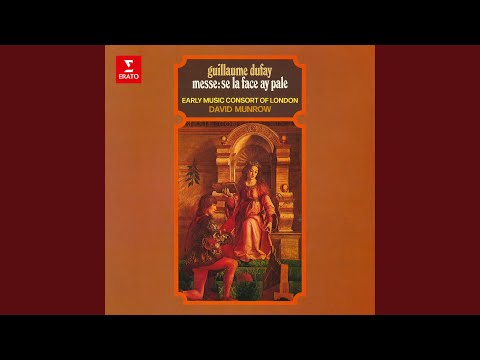
The mass proper that follows (Kyrie through Agnus Dei) is a vocally centered reading with two singers per part, the instrumental consort kept modest, supporting rather than competing with the voices. Critics have noted that this “two-to-a-part plus restrained instruments” setup conveys the work's structural complexity effectively — a departure for Munrow himself at the time, and one that anticipated the performance style that would become standard after 2000.
Listening to the tenor line that forms the backbone of the mass proper, it's worth remembering that this is the very melody of the love song we heard on the Ensemble Unicorn recording. The weight of those “87 chansons” mentioned at the outset wasn't a mere sideline — it had become the flesh and blood of the mass itself.
Hilliard and Munrow — Two Ways of Approaching Dufay
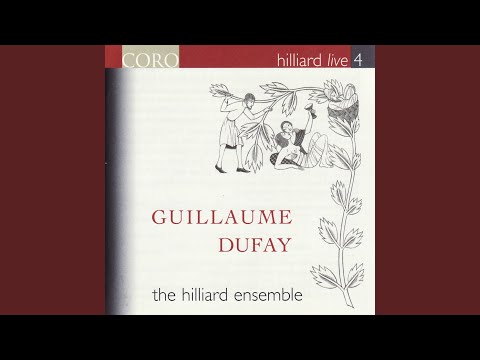
The Hilliard Ensemble performs the same mass with an entirely different sensibility. This group has consistently sung Dufay's music unaccompanied — not just this mass, but his motets too, including Nuper rosarum flores. Choosing to leave out instruments isn't simply a matter of stylistic austerity. There's a pleasure unique to voices alone that instrumental ensembles can't offer — the physical, collaborative act of singers listening to each other's breath, feeling out intonation together, and shaping phrases in real time. What the Hilliard Ensemble's performance offers may be less an experience of “appreciating” Dufay's melody than one of the performers themselves feeling its structure through the instrument of the voice.
Munrow, on the other hand, was after something else: the richness of fifteenth-century musical culture itself. Instrumental performance was widely practiced in that era, especially in secular music. His choice to include a standalone Gloria fragment — untexted, marked only “in the manner of a trumpet” — is telling. This piece was written to work equally well as voices or as instruments. Munrow seems to have heard in it the breadth of a musical world where a single melody could cross freely between media.
There's no need to decide which Dufay is the “correct” one. What the Hilliard Ensemble offers is the pleasure of voices joined together; what Munrow offers is the flexibility of an age in which a single melody was open to both voice and instrument. That the same composer's same melody can yield two such different pleasures says everything about the depth of Dufay's achievement.
Conclusion — A Synthesizer Ahead of Bach
Counterpoint itself was not Dufay's invention. It was already a highly developed technique by the time of the Notre Dame school and the Ars Nova in the twelfth and thirteenth centuries, and Dufay inherited centuries of accumulated practice, folding it into his own style as its great synthesizer. Harmony is a different matter. Setting the sweet consonance of thirds and sixths that came from England alongside the secular harmonic sensibility he cultivated in his own chanson writing — housing these two elements of different origin within a single composer's musical language, and leaving them behind in a notated form readable by posterity — that is Dufay's own particular achievement.
The musicologist Tatsuo Minagawa, in his book Music of the Middle Ages and Renaissance, points out that several distinct lineages coexist in Dufay's style: melodic writing descended from the French polyphonic lyric song tradition since Machaut, isorhythmic construction techniques, an English harmonic sensibility centered on thirds and sixths, an Italian approach favoring melodic primacy, and tendencies pointing toward later functional harmony and contrapuntal construction. French, English, Italian — musical languages that had grown up separately across contemporary Europe all flowed into a single style under Dufay's hand.
This isn't merely a matter of stylistic theory on paper. Over the course of his life, Dufay grew up in the choir at Cambrai, served the Malatesta family in Rimini, Italy, became a singer in the papal choir in Rome, composed for the consecration of Florence Cathedral, and served at the court of Savoy. That multiple styles could coexist within one composer owes something to the fact that he was a working musician who crossed Europe himself, absorbing each region's musical language firsthand.
Dufay's achievement, in other words, lay in doing two different kinds of work at once: synthesizing an existing inheritance of counterpoint, and recording a new harmonic sensibility. He carried the form and sound perfected in England to the continent, combined it with the secular melodic sensibility he cultivated through his enormous output of chansons, and handed the result down to those who came after him — Binchois, Ockeghem, and the Franco-Flemish school as a whole. This work of synthesis and transmission is exactly what earns Dufay a place alongside Bach — another composer who synthesized the styles that preceded him and left the result behind in a form later generations could read.