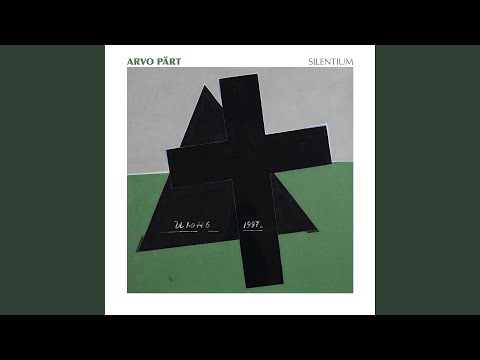
The Most Important Composer in Contemporary Music: Arvo Pärt
In the world of contemporary classical music, if you were to ask who the most widely heard and deeply loved composer is today, the name Arvo Pärt stands at the absolute pinnacle.
In fact, he holds a very special place in my heart as my second favorite classical musician of all time.
Here is a look at just how legendary this aesthetic master is, and how his masterpiece, Tabula Rasa, continues to echo across global media and concert halls.
1. The Living Legend: Just How Important is Arvo Pärt?
Contemporary classical music often carries a reputation for being overly complex or difficult to digest. Arvo Pärt shattered that stereotype. By stripping away musical excess, he created his own unique style known as “tintinnabuli” (Latin for “little bells”)—a minimalist, deeply spatial sound that completely redefined the genre.
Formal Education and a Thorough Exploration of the Avant-Garde
The depth of Pärt's music cannot be understood without acknowledging his formal training and his exhaustive firsthand engagement with the full spectrum of 20th-century compositional technique.
From 1957 to 1963, he studied composition at the Tallinn Conservatory under Heino Eller. But his exploration went far beyond conventional training. During his first creative period (1958–1968), he systematically worked through every major technique of the European avant-garde: twelve-tone serialism (the method developed by Schoenberg), aleatoricism (chance-based composition), collage technique, and sonic field composition. His Nekrolog (1960) was the first serial work written in Estonia and brought him his first international recognition from the West.
This path, however, led to an impasse. After his Credo (1968) was banned by Soviet authorities, Pärt entered nearly eight years of near-silence. During this period he immersed himself in the study of 14th–16th century choral music, Gregorian chant, and the origins of Renaissance polyphony. Having absorbed the most advanced techniques of modernism to their limits, and then turned back toward the ancient roots of Western music, he arrived in 1976 at the tintinnabuli style.
The profound stillness of Pärt's music is the product of a journey few composers have made: mastering the cutting edge of musical modernism, then consciously relinquishing it in pursuit of something more essential. It is this unparalleled musical biography that gives his simplicity its extraordinary depth.
Objective Data Confirms a Global Impact
His global impact is backed by staggering, objective data:
- Dominating the “Most Performed Living Composer” Charts According to Bachtrack, the definitive classical music statistics site, Pärt held the title of the world's most performed living composer for eight consecutive years (2012–2019). Even today, he consistently ranks at the very top alongside cinematic titans like John Williams. His scores are studied and performed by orchestras in every corner of the globe.
- The ECM Label Phenomenon When Manfred Eicher, the founder of the prestigious ECM Records, first heard Pärt's music over a car radio, he was so profoundly moved that he tracked Pärt down to bring his music to the world. Since then, Pärt's albums have become the definitive flagship of ECM New Series, routinely topping classical and crossover charts worldwide.
2. A Masterpiece Dominating Global Media: Tabula Rasa
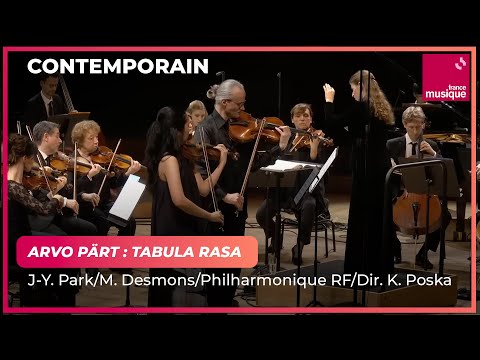
Composed in 1977, Tabula Rasa (Latin for “Clean Slate”) is arguably one of the most significant, heavily rotated, and iconic pieces of the last fifty years. Its reach extends far beyond traditional concert halls, seamlessly embedding itself into modern culture.
Ubiquitous Radio Airplay and Streaming
Step into any major classical radio station worldwide—whether it is BBC Radio 3 in the UK or WCRB in the United States—and you are highly likely to hear Tabula Rasa or Spiegel im Spiegel. They are the gold standard for “ambient, deep-focus music.” On streaming platforms like Spotify and Apple Music, these tracks are permanently featured on editorial playlists for meditation, focus, and modern minimalism, amassing millions of streams daily.
The Ultimate Sound of Contemporary Cinema and Art
The tension, silence, and structural weight of Tabula Rasa have made it a favorite tool for visionary filmmakers and artists.
- Cinema: Famously utilized by Jean-Luc Godard in Nouvelle Vague, and featured heavily in modern cinematic works like A Ghost Story.
- Media & Dance: It is routinely chosen by elite choreographers for contemporary dance and used as the sonic backdrop for high-end minimalist art installations.
Whenever a creator needs to convey an unspeakable depth of human emotion or a breathtaking stillness, the global media landscape turns to Tabula Rasa.
3. Why It Connects: A Personal View
As someone who places Pärt as my second favorite musician, what fascinates me most is the impeccable structure, rhythm, and profound economy of his music.
Listening to Tabula Rasa is a masterclass in architectural beauty. Every single note, every pause, and every shift in rhythm is precisely calculated; there is absolutely zero waste. It delivers the same intellectual and aesthetic satisfaction as looking at a flawlessly written piece of software code or a pristine piece of contemporary abstract art.
In a world full of chaotic noise, Pärt's music continues to dominate the airwaves because it offers the one thing modern listeners desperately crave: an authentic, uncompromising return to silence.
Best I love from his music is this recording of “Silentium” from Tabula Rasa. This piece is really slowly played and the prepared piano sounds like a bell. It's the main reason I like it best.