My favorite regularly use B&O speaker
What speaker do you use? Mine is the Beosound A5 by Bang & Olufsen.
It was an expensive purchase — but I have no regrets.
That said, my first impression was something different. When I first played it out of the box, it sounded like a classic V-shaped speaker — pronounced highs and lows, with a hollow middle. The reputation I had read about and what I was actually hearing did not match. But somewhere after many hours of use — I could not say exactly when — the transition from bass to treble became remarkably smooth, and my whole sense of the speaker shifted. Whether this was the result of physical break-in, or simply my ears adjusting, I cannot say for certain. What I can say is that the sound I hear now is the sound I was looking for. My advice: do not judge this speaker too quickly after unboxing. Give it time.
The Beosound A5 is a portable speaker released in 2023 by Bang & Olufsen, the venerable Danish audio brand. It costs well over 250,000 yen. For a portable speaker, that is an unusual price point — but this speaker gives you every reason to justify it.
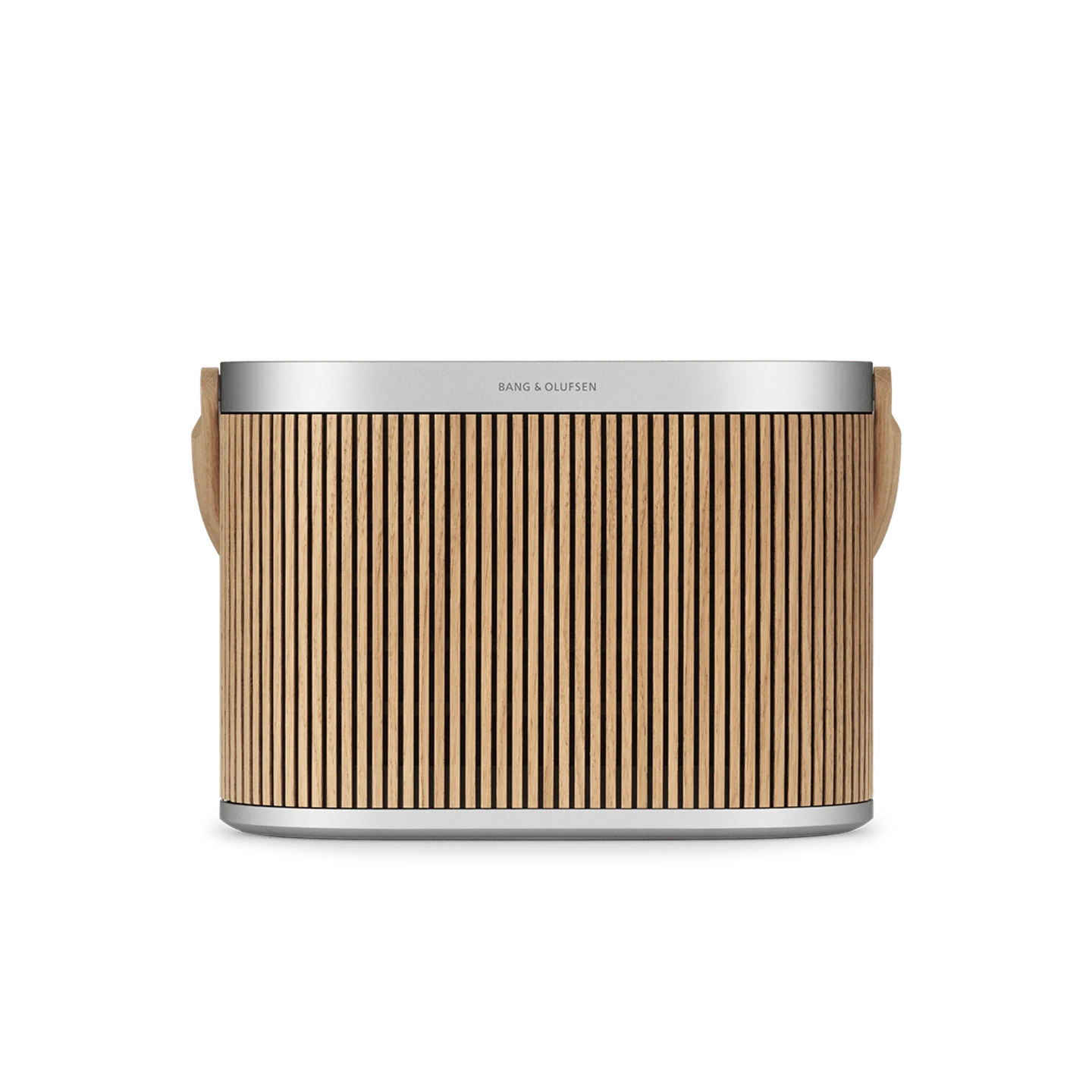
Specifications
| Drivers | 5.25” woofer ×1, 2” full-range ×2, ¾” tweeter ×1 |
| Amplifier | Class D 70W ×4 (280W total) |
| Frequency response | 32Hz–23,000Hz |
| Connectivity | Wi-Fi 6, Bluetooth 5.3, AirPlay 2, Chromecast built-in, Spotify Connect |
| Battery | Up to 12 hours playback, approx. 3 hours charging |
| Water/dust resistance | IP65 |
| Dimensions | 28.5 × 18.7 × 13cm |
| Weight | Approx. 3.7kg |
Sound
A frequency response spanning 32Hz to 23,000Hz, driven by a total of 280 watts of Class D amplification. For a portable speaker of this size, those are remarkable figures — the A5 reproduces the full range from deep bass to delicate highs without sacrifice.
My listening spans post-classical, ambient, environmental music, post-rock, ambient techno, and contemporary jazz. The more nuanced the music, the more a speaker's neutrality is put to the test. The Beosound A5 adds no coloration of its own — it simply delivers what is in the recording. The roar of post-rock, the weight of a techno low end, the overtones of a jazz cymbal: one speaker handles all of it without strain.
Its near-flat response across the full frequency range also means it works well as a monitor speaker when playing instruments. The USB-C port allows it to be connected directly to a PC as an audio output — a flexible option that is not dependent on wireless connectivity.
Bluetooth vs. Wi-Fi — Connection Method Makes a Real Difference
The Beosound A5 supports both Bluetooth and Wi-Fi, but the difference in audio quality between the two is substantial.
Bluetooth has inherently limited bandwidth. After accounting for protocol overhead, the effective throughput falls below 1Mbps — which is not even enough to carry an uncompressed CD-quality stream, which requires 1,411kbps at 16-bit/44.1kHz. This means Bluetooth audio always involves lossy compression. On iPhone, the only supported codecs are SBC and AAC at up to 256kbps — there is no support for LDAC (up to 990kbps) or aptX, which are available on Android and Sony devices. In other words, once you send audio from an iPhone over Bluetooth, the signal degrades to AAC 256kbps regardless of the quality of the source file.
Wi-Fi, by contrast, imposes almost no bandwidth constraints and can carry audio data intact. AirPlay 2 supports lossless transmission up to 24-bit/48kHz, meaning ALAC (Apple Lossless) files arrive without degradation. Chromecast built-in goes further, supporting up to 24-bit/96kHz — though at present, the iOS Apple Music app lacks a Cast button, limiting Chromecast use to Android or PC.
The gap between Wi-Fi and Bluetooth is not a matter of preference — it is a measurable difference backed by numbers. If you have lossless audio files, Wi-Fi is the only way to hear them as intended.
(A note for those using a Bluetooth speaker with an aux input: switch to the aux cable now. The cable may be inconvenient, but Bluetooth is simply inferior when it comes to audio quality.)
Why One Speaker Can Fill a Room
The Beosound A5 is a single, self-contained unit — yet it fills a room in a way that no conventional mono speaker does. The reason lies in the two full-range drivers mounted at the rear.
The front panel houses a woofer and a tweeter. Two 2-inch full-range drivers are positioned at the rear corners, projecting sound not only forward but backward and to the sides as well. Sound directed toward the rear reflects off walls and ceiling, dispersing throughout the room and reaching the listener as something that seems to emanate from the space itself rather than a single point. This is the principle behind what B&O calls Omni mode — 360-degree sound.
A conventional stereo system creates a precise stereo image between two speakers, with a defined sweet spot. That approach offers superior accuracy in sound staging — but the listening experience degrades sharply once you move outside that sweet spot. The Beosound A5's Omni mode prioritizes even dispersion over strict imaging, delivering a consistent and natural sound from any position in the room.
The B&O app allows switching between Omni mode and a front-directed mode called Front. For critical listening, Front mode sharpens the focus; for filling a room with music, Omni is the natural choice. I use Omni as my default. The experience of one speaker making a whole room sing is enough to make the absence of a separate stereo system feel beside the point.
Portable and Battery-Powered
One of the main reasons I chose this speaker is its freedom of placement. The solid oak handle makes it easy to carry from room to room. I bring it into the bedroom, run it on battery, and listen to music as I fall asleep — no cables, no outlet required.
The IP65 rating for dust and water resistance also means it can be taken outside without concern.
A Track to Bring to the Showroom
If you are considering a purchase, I strongly recommend visiting a Bang & Olufsen showroom to audition it in person.
The track I would bring: “Shadow Journal” by Max Richter. It is a recording that draws on the full frequency range — delicate string textures alongside deep, substantial bass. It is an ideal test of whether a speaker can handle the entire spectrum evenly and with authority. The Beosound A5 passes that test with ease.

Design and the Long Game
The Beosound A5 was designed in collaboration with GamFratesi, a Danish-Italian design studio. The rounded form and wooden handle carry forward the aesthetic language of B&O products from the 1960s.
I use the Oak model. The wood finish has the quality of fine furniture. The handle and cover are hand-finished in family-owned woodworking workshops in Denmark — each one individual, with its own grain. B&O holds the position that perfect uniformity looks artificial, and deliberately embraces the natural variation of the wood. The combination of a precision-milled aluminium frame and hand-finished oak gives the speaker the presence of something that belongs in a room, not merely sits in one.
The modular design means individual components can be replaced and software can be updated, extending the speaker's life rather than requiring a full replacement. That philosophy — investing in something well-made and keeping it — is reflected in the object itself.
Not something to replace, but something to keep. In that sense, the Beosound A5 has found a lasting place in my life with music.