My Favorite Bach: The Six Partitas
A propulsion that speaks to modern rock
Bach left behind over 1,000 works under BWV numbers alone. Church cantatas, Passions, oratorios, concertos, fugues — out of this staggering body of work, what draws me in most are the six Partitas. The reason is simple: they hold a contrapuntal drive that speaks to something in modern rock, the kind that makes you want to fall into the rhythm without thinking. Melodic lines chasing each other, generating a beat of their own — that, I think, is the core of what a Partita is.
Why does Bach's music carry this kind of physical propulsion? To understand that, it helps to step back and look at who this composer actually was.
Bach as a wellspring
The BWV catalogue held 1,126 works as of the 20th century; the latest 2022 edition added newly discovered pieces, bringing the total to roughly 1,150. Counting lost works and pieces of disputed authorship in the appendix, the number climbs toward 1,400 in the broadest sense. This body of work isn't just large — it's remained a wellspring that later composers return to again and again, one that never seems to run dry.
Beethoven had reportedly already memorized The Well-Tempered Clavier by the age of eleven. Its influence is written deep into his later string quartets, especially the late works. Mendelssohn, Schumann, Brahms, and Liszt each absorbed Bach's counterpoint into their own musical languages, each in their own way. Into the 20th century, the people drawing from this well never stopped — some as performers, some as composers folding that structure into their own vocabulary. This wellspring shows no sign of drying up.
The birth of opera, and the distance Bach kept from it
Shortly before Bach was born, opera was born in Florence, around 1600. Monteverdi declared that “the words should be the mistress of the harmony, not its servant,” staking out a position that prioritized depicting a dramatic character's emotion in music above all else. This vocabulary of emotional expression eventually spread into instrumental music as well, through what became known as the Doctrine of the Affections, and it became one of the foundations of Baroque music as a whole.
Bach couldn't stay entirely outside this current. But the places where he actually worked kept a consistent distance from the opera house. Church positions in Mühlhausen and Leipzig; court positions in Weimar and Köthen — none of them called for staging opera. In contrast to Handel, born the same year, who set out as a composer of Italian opera and prioritized theatrical effect, Bach never once left the position of church musician. Even in the St Matthew Passion, where he boldly borrowed opera's own vocabulary — recitative, aria — the emotion there never surfaces as theatrical display. It appears only insofar as it's built into the structure of counterpoint.
Abstracted architectural beauty never dries up
What keeps Bach's music from fading even now is that he digested even this material — emotional expression itself — into structure, all while keeping his distance from the theater. Lutheran chorales; the styles of northern and southern Germany (Pachelbel, Buxtehude); Italian style (Vivaldi); French style (Lully, Marais); and even the emotional expression that had come out of opera — he took all of these varied materials and set them, in universal form, into the abstract logical structure of counterpoint.
At the heart of this sits the device of the fugue. A fugue (fuga, Italian for “flight”) is built on a single subject chased across multiple voices, staggered in time. Because the structure can be followed purely through the logical relationships between voices — answer, inversion, augmentation, diminution — it holds together even for a listener with no knowledge of its religious or regional context. That a work like The Art of Fugue doesn't even specify which instruments should play it is the furthest extension of this idea. Bach absorbed so many regional traditions that he became a composer no longer reducible to any single one of them. That's precisely why his music stays open to ears with no knowledge of its original cultural background.
Music that was once dismissed as “too complicated”
That universality wasn't grasped by his contemporaries right away, though. In 1737, the music critic Johann Adolf Scheibe wrote of Bach: “This great man would be the wonder of all nations if he had a more pleasing style, and if he did not spoil his compositions by bombast and intricacies, and by excess of art hide their beauty.” The musical world of the time was moving toward the simpler, more approachable galant style, and Bach was seen as outdated and impenetrable. Even his own sons reportedly found their father's style old-fashioned.
After his death, Bach's music was largely forgotten for decades. It resurfaced in 1829, when a twenty-year-old Mendelssohn conducted the St Matthew Passion in Berlin — the first public performance of the work in a full century. This “Bach Revival” was no simple restaging. Mendelssohn cut roughly a third of the arias and about half the choruses, replaced the Baroque wind instruments with instruments like the clarinet, and personally penciled in the dynamics and phrasing that Bach had originally left to the performer's discretion. According to musicologists, his aim was twofold: a dramatic concentration on the biblical text, and an intensification of emotion in the Romantic sense. Right as Romantic music was blossoming in Germany, the story of a buried genius took on an emotional charge of its own, and a work like the St Matthew Passion — with its operatic, dramatic elements — was resurrected through an intensely emotional interpretation.
The other path: a non-emotional reading
From there, the reception of Bach kept branching further. In the latter half of the 20th century, the jazz pianist Keith Jarrett recorded The Well-Tempered Clavier (Book I on piano, Book II on harpsichord) and the Goldberg Variations (harpsichord) for ECM. His interpretation runs in a direction opposite to Mendelssohn's infusion of Romantic feeling. Critics have described it as marked by “poetic restraint,” a refusal to “impose his personality unduly on the music,” a deep attunement to “the process of thought in Bach,” a “cool temperature” and “restrained expression.” That Jarrett — a master improviser — deliberately holds himself back places him at the opposite pole from Mendelssohn.
Part of what makes this possible is that Bach's own scores leave almost no dynamic or expressive markings. Because so much is left open to the performer's discretion, both paths become possible: pouring in Romantic feeling the way Mendelssohn did, or letting the structure itself come to the surface the way Jarrett does. A major reason Bach has been received across so many different eras is precisely this: he left behind a score that permits so many different readings.
And still, what draws me in is the Partitas
The Partitas were originally dance suites — made up of movements like the allemande, courante, sarabande, and gigue, all rooted in actual courtly dance. But Bach placed at the head of each one a free, large-scale opening movement that isn't a dance at all — a prelude, a sinfonia, a fantasia, an overture. That's the core of the form: he elevated the dance suite past mere accompaniment for dancing, into a piece of instrumental architecture in its own right. No one conveys that physicality more eloquently, I think, than András Schiff.
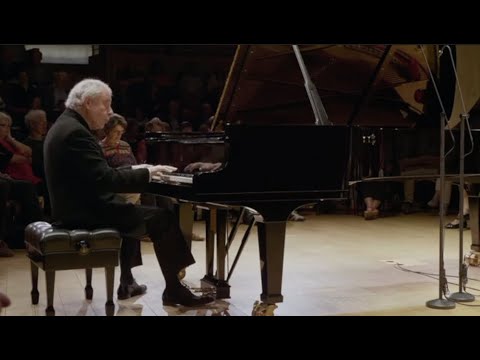
Of his 2007 live recording for ECM, one review put it this way: Schiff “sings and dances the music, always propelling the rhythmic line.” His tempos are brisk, driven hard, and pinpoint the music's roots in dance.
You can't play Bach at that tempo while your eyes are tracking a score. And in fact, Schiff plays these works from memory. When he performed the complete Book I of The Well-Tempered Clavier from memory at the BBC Proms in 2017, a critic wrote that it seemed extraordinary at first, “but this is music he has lived with most of his life.” Schiff himself has said that for more than fifty years, he's started nearly every morning with about an hour of Bach — “even before breakfast. It's like taking care of your inner hygiene.” Playing this many movements of interwoven, complicated counterpoint at this speed, with no score in front of him — that's not simply a feat of memory. I think it's what happens when the music theory of Bach itself, through daily repetition, becomes something natural enough to live in the fingers.