800-Year-Old Ambient Music: Why 12th-Century “Organum” Sounds So New Today
Introduction
Tatsuo Minagawa, a pioneer of medieval music scholarship in Japan, reportedly received strange letters for years. The senders were young people who never listened to Mozart or Beethoven, yet wrote that medieval early music had moved them deeply, beyond any explanation.
I think I understand that feeling. Playing Trio Mediæval while reading a book, I was struck by how little it interrupted my concentration. And yet, when I paused to actually listen, the music turned out to be remarkably interesting. It matches, almost exactly, Brian Eno's famous definition of ambient music: “as ignorable as it is interesting.” An 800-year-old voice fits that description perfectly.
Why does this 12th-century sound feel so new to us now? Two landmark recordings hold the key. Three women's voices, and four men's voices. Music whose composer's name was lost, and music that entered history as the work of “the first composer.” Trio Mediæval and the Hilliard Ensemble — let these two recordings guide us on a journey into the acoustic revolution of 12th-century Paris.
Chapter 1: From Sounds That Vanished to Sounds That Were Written Down
In the age of monophony, epitomized by Gregorian chant, music was carried entirely by oral transmission — sung, and then gone.
Around the 9th century, the first attempts emerged to fix the voice on paper. According to Minagawa, the drone-like sustained lower voice that appears around this time may trace back to the liturgical practice of the Byzantine church. Given that the Frankish kingdom expanded its territory while in contact with the Byzantine sphere of influence, this is far from implausible.
One caution is worth raising here: the shift from monophony to polyphony should not be told as a simple story of “evolution.” Singing in multiple voices at once is not a European invention — it is a widespread human impulse found across popular and traditional musics around the world. What was distinctive about Europe was that this popular practice encountered the institution of the Church and the technology of notation, and was systematized there.
The stage eventually shifts as well — from the closed prayer of the monastery to the cathedral at the heart of the city. That center was Notre-Dame in Paris. Around the same time, church architecture itself was undergoing a parallel transformation, moving toward the Gothic style — ribbed vaults and flying buttresses lifting ceilings ever higher. The same desire to fill space was unfolding simultaneously in both architecture and music.
Chapter 2: Trio Mediæval — Recovering the Voices Without Names
At the center of this transformation stand two names history remembers: Léonin and Pérotin. Léonin's Magnus Liber Organi was expanded by Pérotin into three- and four-voice polyphony. This is sometimes told as the moment the very concept of “the composer” was first attached to a name.
But within that same pile of 12th-century Parisian manuscripts lay countless other voices that were never named at all. Stella Maris, released by Trio Mediæval on ECM in 2005, shines light on precisely that unnamed side. Nearly all the pieces on the album are credited as anonymous. And crucially, these works were composed at a time when women were not expected to sing them — or even to hear them. This recording, then, fills a double absence: the anonymity that was never recorded, and the gender that was never given a voice.
The title track, “O Maria, stella maris,” embodies this. Over a low, sustained drone, a single voice begins, then divides, and multiple lines intertwine.
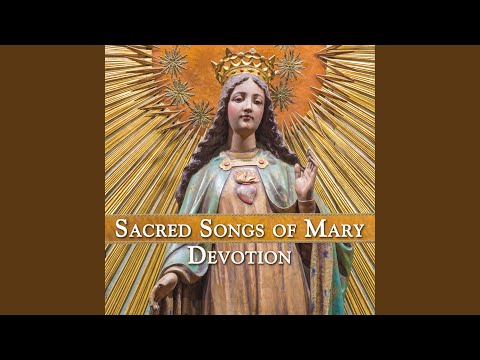
As the musicologist Akio Okada has noted, in early organum the newly added voice was merely a decorative accompaniment to the chant. But over time, this supporting voice came to carry equal weight with the principal melody, and the hierarchy between melody and accompaniment itself began to dissolve. What Trio Mediæval sings is music caught in the midst of that very dissolution.
Trio Mediæval also recorded two 12th-century Italian laude on their 2014 album Aquilonis.
Chapter 3: The Hilliard Ensemble — The Uncertain Shape of Pérotin
Standing opposite this anonymity is Perotin, recorded by the Hilliard Ensemble for ECM in 1989. The four-voice male ensemble embodies the depth and force of the four-voice organa Pérotin pioneered — “Viderunt omnes” and “Sederunt principes.” If the verticality of Gothic architecture expressed the glory of God to the eye, this layered four-voice sound expressed the same thing to the ear: architecture made of sound. Within the constraint that liturgical music of the time could only be sung by men, this was also a question of how much grandeur could be drawn from those limited resources.
What is striking is that Perotin itself carefully distinguishes, in its credits, between works confidently attributed to Pérotin and those marked “Anonymus.” The outline of “the first named composer” turns out to rest on an uncertain sea where confirmed authorship, scholarly conjecture, and contemporary anonymity are all mixed together. The Hilliard recording, which reenacts an established authority, stands at its root on the same ground as the anonymous voices recovered by Trio Mediæval.
Conclusion: Two Twelfth Centuries, and a Present-Day Solitude
A recording that gives voice to the authority of an established composer, and a recording that recovers, for the first time, voices that were never recorded at all. That these two very different albums sit side by side in the same ECM catalogue may not be a coincidence.
What both share is the absence of a fixed hierarchy between melody and accompaniment, and the absence of any strong gravitational pull toward resolution. Beyond that, two further qualities link them to contemporary ambient music. The first is spatial: voices sung within stone cathedrals and monasteries carried long reverberation, repeating and dissolving into one another — the same expansive sound field that ambient music deliberately constructs today through reverb. The second is how the voices appear: the upper voices of organum rise unannounced from a single line and fade away just as silently. Rather than melodies with clear beginnings and endings, they behave more like sounds that surface briefly within a space, then sink back down. This is why, to ears worn thin by the human drama of joy and sorrow that 18th- and 19th-century “classical music” cultivated, the voices of the 12th century sound, paradoxically, new.
And in fact, when I played Trio Mediæval while reading, the voices never once interrupted me. They simply dissolved into the air of the room — and only when I looked up and listened closely did I notice the precision of what was there. That, unmistakably, was the feeling of listening to ambient music.
Put on headphones, and turn off the lights in the room. The reverberation that once filled a stone space 800 years ago, and the solitude we carry today, are connected by a voice that rises without warning, and fades just as quietly.
References
Tatsuo Minagawa, Chūsei, Runessansu no Ongaku (Kodansha Gakujutsu Bunko)
Akio Okada, Seiyō Ongaku-shi: “Kurashikku” no Tasogare (Chūkō Shinsho)